

From Hardship to Resilience: Your Nonprofit's Funding Strategy

Over the last few years, nonprofit leaders have been asked to do more with less, indefinitely. Budgets have tightened, but the needs the sector exists to meet have only continued to grow.
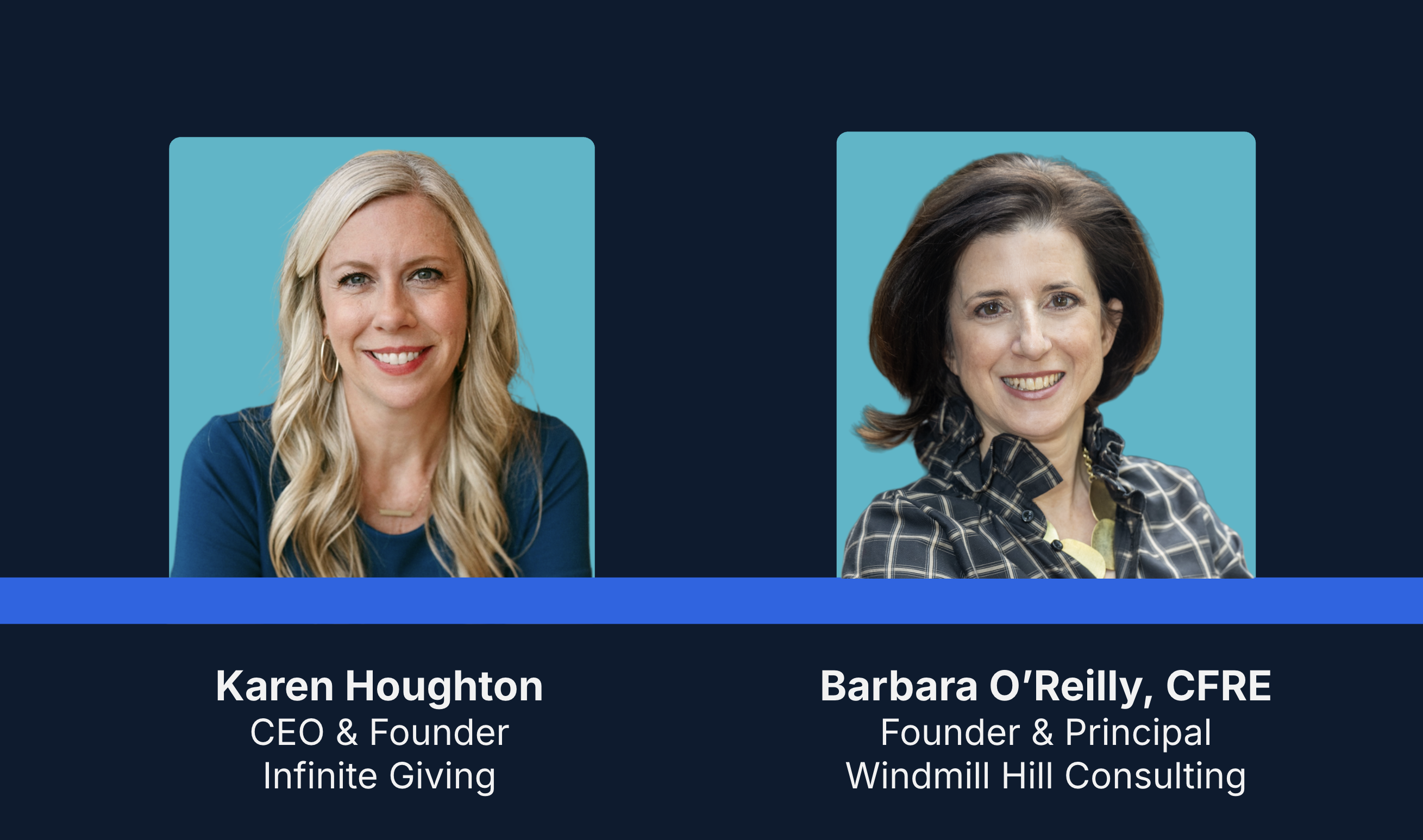
That was the honest starting point for our webinar where Infinite Giving CEO Karen Houghton sat down with Barbara O'Reilly, CFRE, founder and principal of Windmill Hill Consulting, to talk about turning hardship into resilience and building a real strategy to scale generosity.
Barbara brings nearly 35 years of fundraising experience to the conversation, including work through recessions, a global pandemic, and political and social unrest. Her core message: this moment calls for clarity and confidence, not scarcity thinking.
The decline in giving isn't the whole story
GivingUSA's annual report, produced with the Indiana University Lilly Family School of Philanthropy, has tracked a slow, steady 20-year decline in individual giving as a share of overall philanthropy. It's easy to read that as bad news for nonprofits. But Barbara offered an important reframe: donors haven't stopped giving. They have more ways to give than ever, and a lot of that generosity is now flowing through asset gifts, crowdfunding, mutual aid, and peer-to-peer platforms instead of traditional nonprofit channels.
Barbara traced part of this back to a broader shift in how connected we are as communities. Referencing Robert Putnam's Bowling Alone, she pointed out that as civic and religious participation has declined over the past few decades, so has the social modeling that once made giving and volunteering a visible, shared norm. That shift is largely outside any single nonprofit's control.
What is in your control is how you build relationships with the donors who do want to stay connected. Donor retention sits at just over 40%, down from around 50% a decade ago — a clear signal that there's more room to build the kind of stewardship that keeps supporters around for the long haul.
Get radically clear on your financial picture
Before you can build a resilient fundraising strategy, Barbara said, you need an honest, detailed view of your organization's finances: your cash flow, the cyclicality of your revenue, and your full mix of funding sources. That means going beyond "did we hit the number?" to ask harder questions. Was last year's growth driven by sustained donor relationships, or by a one-time bequest that's now skewing your baseline?
Many organizations learned this the hard way after unusually strong COVID-era giving made it tempting to set future goals off an anomaly year.
Barbara also encouraged fundraising and finance teams to talk to each other far more than they typically do. The two functions are often disconnected, speaking past each other on things like pledges versus cash in hand, even though they're ultimately solving the same problem together.
That same financial clarity applies to cash you're already holding. If your reserves are sitting in a checking account, they're likely losing value in real terms.That’s where cash management can help make a difference by having enough to grow without fear and to keep doing the work when the unexpected happens.
She shared a striking example: a nonprofit that faced funding cuts tied to the executive orders that took effect in January 2025 was able to respond with confidence specifically because it had already built financial forecasting and reserve scenarios into its planning.
.png)
The “Assess, Dream, Plan, Do” framework
Barbara walked through Windmill Hill's Clarity to Action framework, a four-step approach for organizations ready to scale:
- Assess starts with an honest audit of your data, including your finances, fundraising trends, and the gaps and opportunities hiding in both.
- Dream is the step organizations most often skip, and Barbara argued it might be the most important. She encourages leaders to set aside current constraints entirely and ask what the organization would look like operating at its fullest potential. That bigger vision becomes the story you tell donors, and it changes the size and shape of the asks you're able to make. A $1,000 gift framed against solving a community's food insecurity looks very different from that same gift framed against a $10 million, five-year initiative.
- Plan turns that vision into a tactical, multi-year development plan, with clear resources and conditions needed to get there.
- Do is about implementation that's sustainable, realistic, and scalable — not a plan that looks great on paper but burns out your team in year one.
Make it easy for donors to give the way they want to
One of Barbara's clearest points: giving is personal. Donors are making a statement about who they want to be, and the organizations that treat every touchpoint as a solicitation, rather than a relationship, are leaving both trust and revenue on the table. In fact, roughly 80% of first-time donors never make a second gift, often because they didn't feel seen or valued after that first one.
Barbara pointed to Ken Burnett's classic Relationship Fundraising as a guide here: build two-way relationships, ask donors about their philanthropic priorities, and make it easy for them to give however works best for them — appreciated stock, donor-advised funds (DAFs), qualified charitable distributions (QCDs), or even cryptocurrency.
You don't need to be the expert in every giving vehicle. You just need the infrastructure and the confidence to bring it up.
Bring your board into the work
Boards are often positioned as a fundraising bottleneck, and Barbara's advice was refreshingly practical: most of the friction comes from unclear expectations. Define what fundraising actually means for your board from the very first recruitment conversation, offer real training, and meet with each board member individually to find the two or three ways they're genuinely comfortable contributing.
Board terms, she noted, are your friend as they create a natural, non-awkward off-ramp for members who aren't engaged, without anyone having to force an uncomfortable conversation.
One thing to do this week
If you take just one step from this conversation, Barbara suggested sitting down with your finance team or finance committee to look at your numbers together, then reviewing your donor data to understand your retention trends and where the real gaps are. From there, look at whether your cash on hand could be working a little harder for you.
Barbara closed with a reminder that matters as much as any tactic: take care of yourself and your team. Burnout is real, and part of building a sustainable strategy is being honest about what no longer serves the organization, so you can protect your time for the work that does.
This is exactly the kind of work Infinite Giving exists to support. We help nonprofits build the financial infrastructure to receive major gifts, manage cash, create endowments, and plan for the long term. If you'd like to talk through what that could look like for your organization, schedule an introductory call to get started.
Explore More
Webinars
Articles

Grow Your Giving with Expert Nonprofit Financial Advice
