There's a good chance that when you hear "Giving Tuesday is coming," your first reaction is either "we have plenty of time" or "oh my gosh, it's almost the holidays?!" Both reactions are understandable. Giving season can feel like a sprint: campaigns to build, emails to write, social posts to schedule, goals to hit, boards to activate, and money to raise.
But what if, instead of approaching Giving Season with anxiety, we approached with curiosity? Instead of asking "how do we get people to give," what if we asked what our giving partners care about right now, what they want to accomplish, and how we can invite them into the work?
That reframe was at the heart of a recent Infinite Giving webinar with Karen Houghton, CEO & Founder of Infinite Giving and author of Funding Your Mission, and Joanna Hogan, Founder & Principal of Inspire Generosity. Joanna helps nonprofit leaders learn to inspire generosity rather than chase it.
Watch the webinar replay of "Laying the Foundation for Year-End Generosity in Giving Season & Beyond"
Be curious, not anxious
Joanna's central idea is simple but hard to practice: it's difficult to be highly curious and anxious at the same time. When fundraisers walk into a meeting focused on their own performance, including what to say, what to wear, what not to mess up, you name it. And that anxiety shows, and it makes the conversation awkward for everyone.
Turning the focus outward, toward genuinely getting to know the person across the table, changes the entire posture of the conversation. And it's not only a nerves-management trick, but also creating a meaningful giving experience for someone requires actually knowing them well.
So what should nonprofit leaders be curious about? Joanna's starting question: what does this person want to accomplish with their money that's meaningful to them?
From there, it's worth exploring how they make giving decisions, who they make them with, and what the best giving experience they've ever had looked like — asked not in a solicitation meeting, but in an open, exploratory conversation. Karen added one of her own favorites:
"When you look back at your life, what do you want your legacy to be?"
It's a bigger, more generous question than "what do you want your impact to be?" as it tends to open doors that a pitch never could.
One important caveat: curiosity isn't the same as ambushing someone. If you're requesting a meeting, be upfront about why. As Joanna put it, the rule is no surprises, and to let your supporter know whether it's a relationship-building conversation or a gift conversation, and let them choose the format that works for them.
Why start now, not November
GivingTuesday began in 2012 as a simple idea: pick a day that encourages people to do good. What started as a single campaign has grown, over the last 14 years, into a global movement that inspires hundreds of millions of people to give. It creates real urgency and momentum; however, the relationships that inspire major gifts and long-term generosity are built all year long, not in the six weeks before December 31.
Joanna's advice: talk to people at times when you don't need anything from them. Some of the best conversations happen when there's no ask on the table. Set a personal goal for significant visits every month, all year-round. Because a gift conversation can happen whenever the person is ready for it, not just when your calendar says it's Giving Season.
From "the ask" to an invitation
"Making the ask" is baked into fundraising language, but Joanna encourages a shift toward thinking of it as an invitation instead. Asking someone for something can position them as a rescuer and you as the one in need, which is uncomfortable for everyone involved.
An invitation, on the other hand, is about inviting someone to participate in something. That’s a lot easier to say yes or no to an invitation than to escape the guilt of turning down an ask.
That doesn't mean every person is the right fit for every invitation. When someone's passion clearly points somewhere else, Joanna's advice is to "bless and release" instead of chasing a relationship that isn't aligned. This helps to connect that person to a cause. Ultimately, that’s better for everyone, and it tends to be remembered.
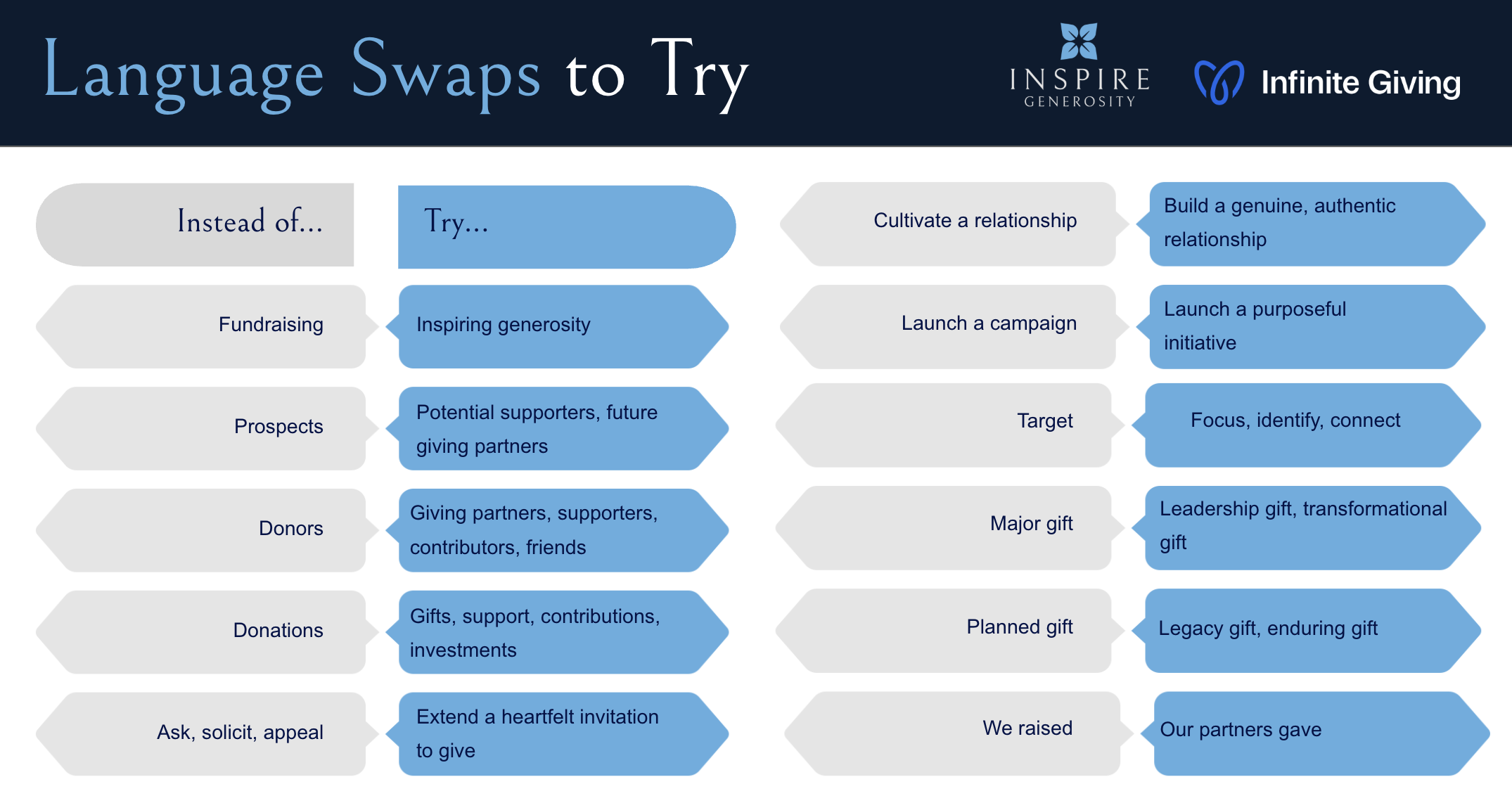
Language that makes giving feel less transactional and more relational
Small word choices shape the posture of an entire relationship. A few shifts Joanna recommends:
- Donor → Giving Partner, supporter, contributor, or friend. "Donor" isn't a bad word, but it defines someone by their gift rather than by the relationship and shared purpose you're building together.
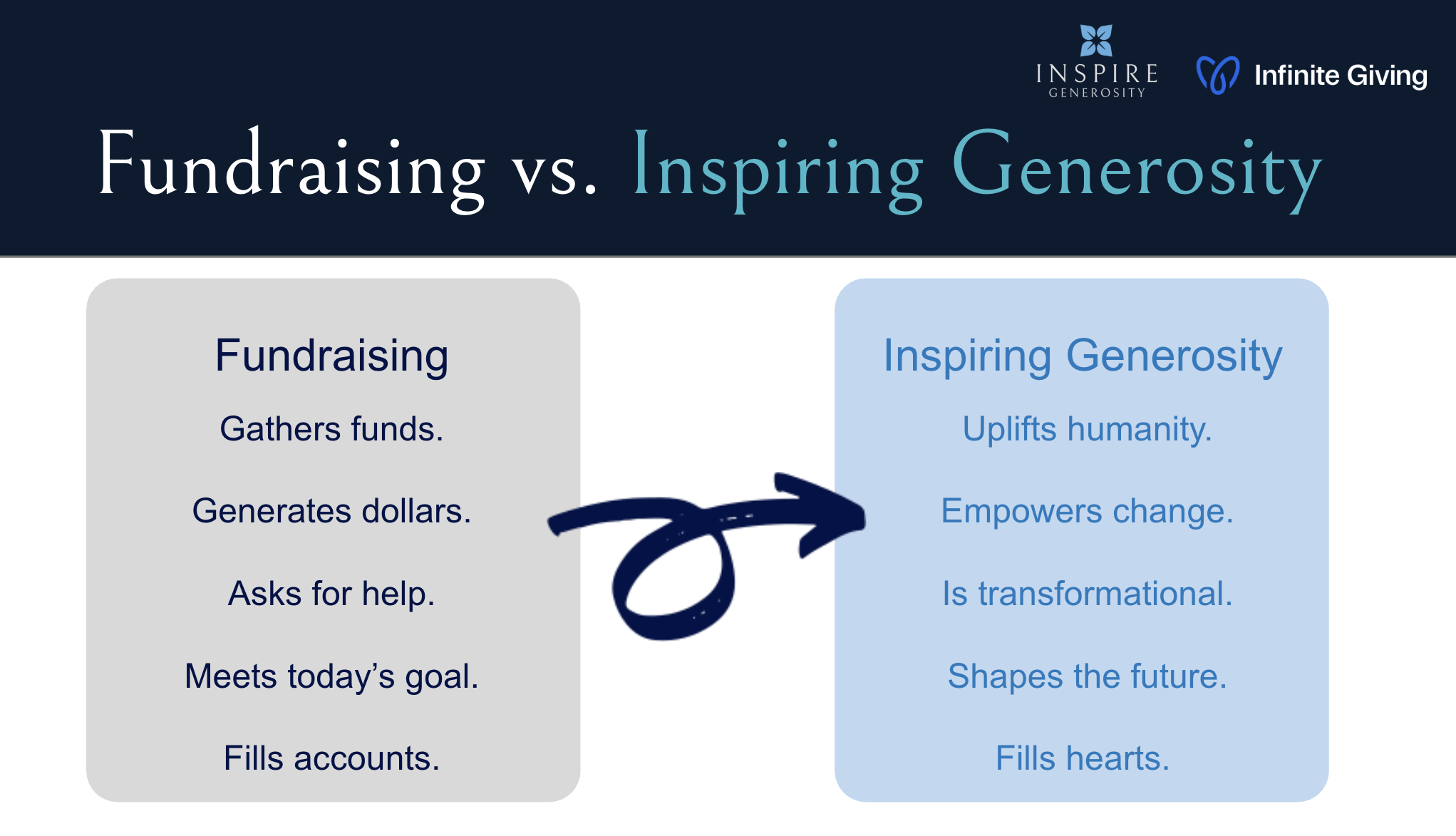
- Fundraising → Inspiring Generosity. Fundraising is about how you get money from people to do your work. Inspiring generosity is about helping people do what they already want to do.
- "We raised X" → "Our partners gave X." A small reframe that gives credit where it belongs.
- Ask → Invitation (or solicit/appeal → a heartfelt invitation to give).
If you only change two things, Joanna suggested making it these: donor becomes giving partner, and ask becomes invitation.
Balancing warmth and urgency
Nonprofits have real financial goals and real year-end deadlines, plus that pressure doesn't disappear. Joanna draws a distinction between two situations. If an organization is genuinely in crisis, the priority has to be stabilizing, because approaching giving partners from a place of crisis isn't fair to them or to your team.
Outside of crisis, the discipline is being efficient with your time: focus on the fewer, right relationships such as people with capacity, a track record of generosity, and genuine interest in your mission vs. spreading urgency across a long list.
Karen connected this directly to financial stewardship: sustainable giving conversations are much easier to have when an organization can speak from a place of confidence, such as a healthy reserve, a long-term financial plan, and evidence that you'll still be doing this work for the long-term and years to come.
That confidence matters especially when you're talking about legacy gifts or multi-year commitments; givers can tell when an organization is planning for the long haul versus lurching from crisis to crisis.
Meet givers where their wealth actually is
One of the most practical points in the conversation: roughly 90% of wealth in the U.S. is held in assets, not cash. And yet, most year-end campaigns only ask for credit card, debit, or ACH gifts. That's a significant missed opportunity, particularly with more generous givers.
Non-cash gifts also tend to be dramatically larger: Joanna cited research suggesting the average non-cash gift runs roughly 62X the size of the average cash gift, and Karen noted the average online cash gift is around $128, compared to $7,000–$8,000 for a national average stock gift.

This is exactly where Infinite Giving's platform comes in. Being able to talk confidently about stock gifts, donor-advised funds (DAFs), crypto, and legacy or endowment giving, plus having the infrastructure to actually receive and steward these gifts, means those conversations don't stall out at "let me check with our finance team."
Infinite Giving gives nonprofits the tools to accept and steward stock, DAF, crypto, and other non-cash gifts alongside cash, so that when a giving partner is ready to give in the way that makes the most sense for them, the answer is already yes.
What makes a giving experience meaningful
The answer, again, comes back to knowing someone. What feels meaningful to one giving partner through public recognition, a handwritten note, a quiet coffee talk or lunch together, may not be what another supporter wants or needs. There's no universal formula for recognizing your giving partners’ contributions. This is exactly why a smaller portfolio of well-known relationships tends to outperform a broad, shallow one for both the giving partner's experience and for the fundraiser's own enjoyment of the work.
Board resistance to fundraising
Board resistance to fundraising often comes down to trust. And for some boards, they might have been told to "give or get" without ever being shown the fuller picture of what meaningful involvement could look like.
Joanna's approach starts with individual relationships: talking with each board member about their own giving, what a great board experience would look like for them, and how they'd like to contribute vs. treating "the board" as one interchangeable group.
On giving requirements specifically, Joanna favors 100% board participation, communicated clearly and revisited throughout the year, rather than either extreme of no expectation at all or a steep dollar minimum.
Building the culture, not just the language
Language changes are a starting point, not the finish line. For a shift like this to stick, it has to be practiced (and understood), not just adopted as new vocabulary. Joanna's own accountability trick: her retreat alumni meet monthly and gently call each other out (with a Zoom reaction, not a scolding) any time "the D-word" slips out. The point is bot about policing language but instead it's building a shared understanding of why the shift matters, and making the work more enjoyable in the process.
One change before year-end
If a nonprofit leader changes just one thing before year-end, Joanna's recommendation is this: identify exactly who you're planning to meet with over the coming months. Do they have capacity, a track record of generosity, and real interest in your mission? Do they know you? Then set a concrete goal for how many of those visits you'll actually have. That's the piece within your control by creating the conditions for generosity to flow.
Measuring whether it's working
Money is a lagging indicator here, not a leading one. The first signs that this shift is working show up in the relationships themselves: people warming up, boards becoming more engaged, conversations feeling genuine rather than like a pitch. Retention and turnover statistics shift eventually; however, the earliest, most reliable signal is simply how people are experiencing you.
Where to start
Maybe your last appeal used the word "ask" five times. Maybe your board has never been invited to do anything beyond writing a check. Maybe "donor" is baked into every template you own.
So ask yourself three questions:
- Who are we only talking to when we need something?
- How well do we actually know our giving partners?
- Are we creating opportunities for generosity, or primarily trying to reach a fundraising goal?
If the answer to any of those gives you pause, that's okay… because now you know where to start.
The biggest takeaway from this conversation is that inspiring generosity starts long before Giving Tuesday, and so much of it centers on how we think about our giving partners and the opportunities we're inviting them into.
Don't wait for the perfect year-end campaign. Start with one invitation this week.
Want the full conversation? Watch the complete webinar recording for Karen and Joanna's discussion on Inspiring Generosity.
.png)