Behind every reserve fund and endowment is a mission: a meal served, a student mentored, a family welcomed home. That's what we keep in view when markets move, and the third quarter of 2026 brought plenty of movement.
For the first time since 2023, the Federal Reserve raised interest rates. Treasury yields reached their highest levels in about 24 years, bonds had their toughest quarter since 2022, and large U.S. stocks still edged higher. There's good news in that mix for nonprofits: cash, reserves, and high-quality short-term bonds are earning more income than they have in many years.
Here's a plain-language look at what happened and the questions worth bringing to your next board or finance committee meeting.
The short version of rate volatility
- The Fed shifted from holding to tightening. A July hold gave way to a unanimous quarter-point hike in September, bringing the target range to 3.75% to 4.00%.
- The economy is running warm, but hiring is slowing. The Atlanta Fed estimates Q3 growth at 3.6%, while September payrolls rose by only 29,000 jobs.
- Inflation remains above target. September consumer prices rose 3.7% from a year earlier, led by gasoline.
- Bonds fell, but income reset higher. The broad U.S. bond index lost 3.51% in Q3, and its yield rose to 5.56% from 4.32% in January.
- Stock gains were narrow. The S&P 500 returned 2.3% in Q3 and 12.7% year to date, but only four of its 11 sectors rose.
- Giving is at a record, but many nonprofits feel strain. Americans gave $617.2 billion in 2025, yet 36% of nonprofits surveyed report reduced federal funding.
The Fed moved from easing to tightening
Citing elevated inflation, driven partly by energy prices, the Federal Open Market Committee raised its target range by 0.25 percentage points on September 16. In July, three committee members had already voted for a hike. Fed officials' median projection now implies one more increase in 2026, with rates easing gradually after that.
Markets have gone back and forth on what comes next. The odds of another hike at the October 28 meeting fell from 73% to 17% after a weak jobs report, then climbed back to roughly 43% to 49% after a hotter-than-expected inflation report on October 14.
The Treasury yield curve now slopes upward: the 10-year yield was 5.29% on September 30, up from 4.44% at the end of June, and 41 basis points (0.41 percentage points) above the 2-year. In practical terms, reserves committed for longer currently earn more than overnight cash.

Growth is running warm, and inflation is sticky
The U.S. economy grew faster than expected, powered by AI-related business investment. Second-quarter growth was revised up to 2.2%, and early estimates for the third quarter are higher still.
Two things are worth watching closely. First, hiring has slowed: September added just 29,000 jobs, and unemployment rose to 4.2%. Government payrolls are down 216,000 over the past 12 months, which matters for organizations that rely on public funding.
Second, inflation is still above the Fed's 2% target. Core PCE, the Fed's preferred gauge, was 3.0% in August, and gasoline prices are up 34.2% from a year ago.
For nonprofits, these forces show up in program costs, donor confidence and public funding, so they're worth building into your budget assumptions.
Stocks edged higher, but gains were narrow
Large U.S. companies rose on AI-related earnings while smaller companies fell. The Russell 2000 index of small U.S. companies lost 7.2% in the quarter, and rate-sensitive sectors such as utilities and real estate were hit hardest by rising yields.

The market is also more concentrated than usual. The 10 largest stocks make up 40.6% of the S&P 500, and valuations sit above their 30-year average. For endowments built to serve future generations, a narrow market is a good reminder of why diversification and discipline matter more than trying to time the market.
Bonds slipped, and starting yields reset
When interest rates rise, the prices of existing bonds fall, and longer-term bonds fall the most. That's exactly what happened in Q3: long-term Treasuries lost 8.9%, while short-term Treasury bills gained 0.9%.
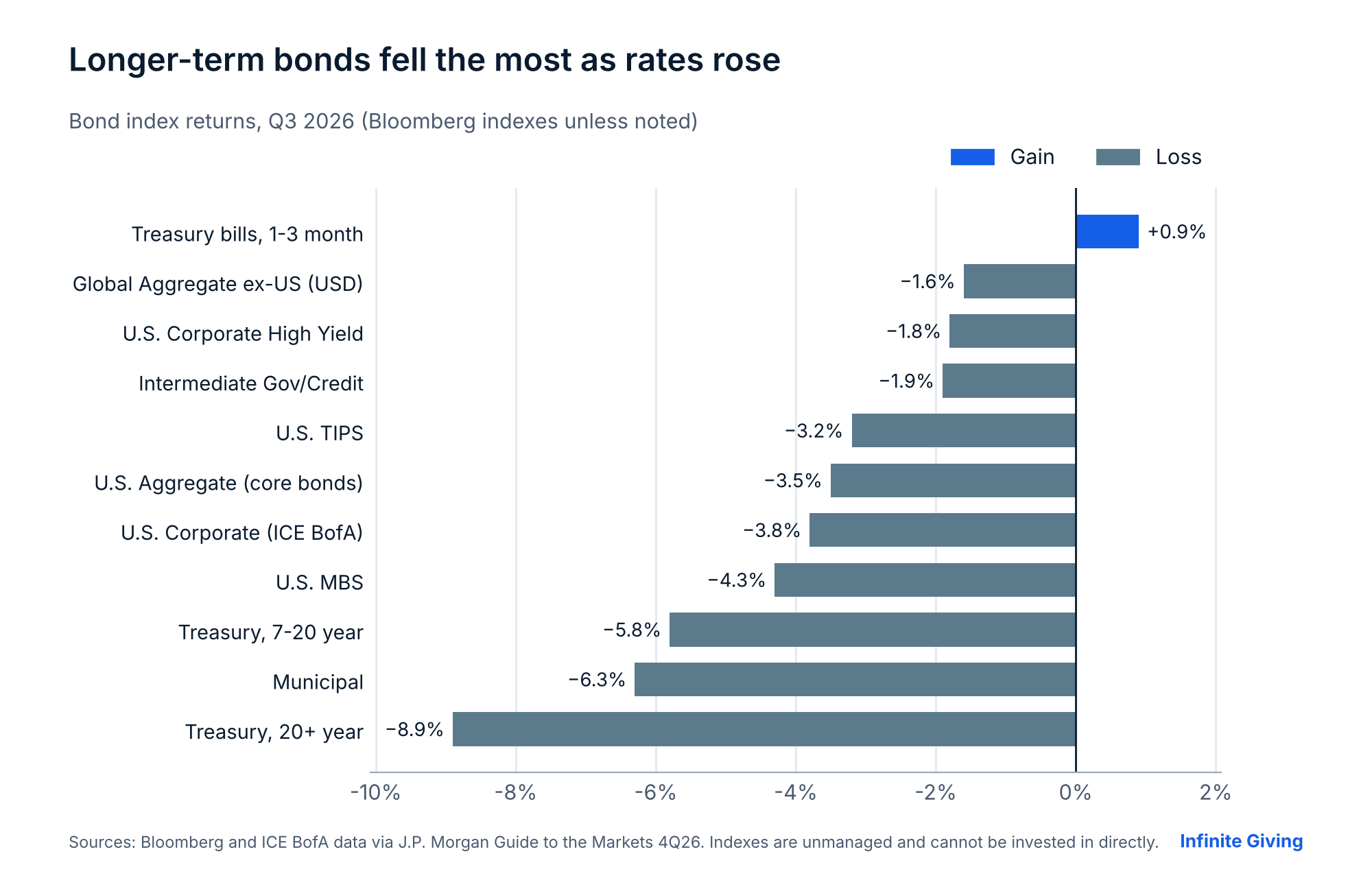
There's a brighter side. New bonds now pay meaningfully more income, which can help long-term funds support mission spending. According to J.P. Morgan, starting yields have explained 89% of the variation in five-year returns for the broad bond index since 1976, though past relationships may not hold. Higher income today can offset much of the price decline from a further rise in rates.
Cash earns more, and the question has changed
In 2024 and 2025, many boards were cautioned that falling rates would reduce income on cash. In 2026, Treasury bills and money market funds pay above 4%: the 13-week Treasury bill yielded 4.19% at its October 13 auction.
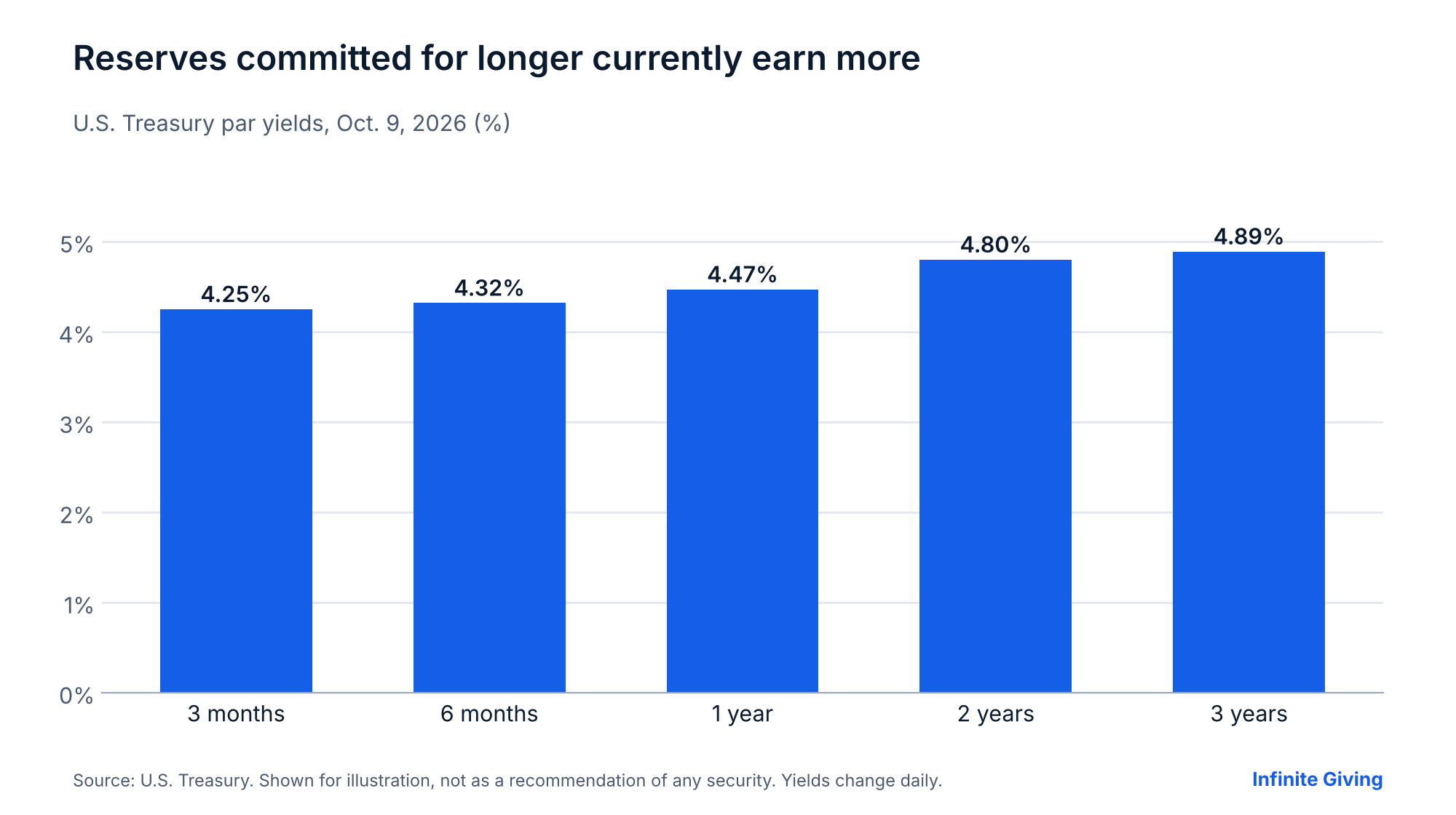
The question for boards now is how reserves are structured. Reserves held only in overnight vehicles see their income reset every time short-term rates move. If expectations for further rate hikes prove overdone, as BlackRock has suggested, short-term yields could fall and that income would drop with them.
One common approach is to think about reserves in tiers:
- Operating liquidity: payroll, programs and other near-term needs, often several months of expenses, kept in highly liquid vehicles such as government money market funds or Treasury bills.
- A reserve ladder: staggered Treasury maturities, for example from three months to three years, so a portion matures regularly. A ladder can reduce the impact of rates moving either way.
- Long-term funds: board-designated or quasi-endowment funds invested to sustain the mission over a longer horizon, as set out in your investment policy statement (IPS).
The right amounts and vehicles depend on each organization's cash flow, IPS, liquidity needs and risk tolerance.
Philanthropy is resilient, but shifting
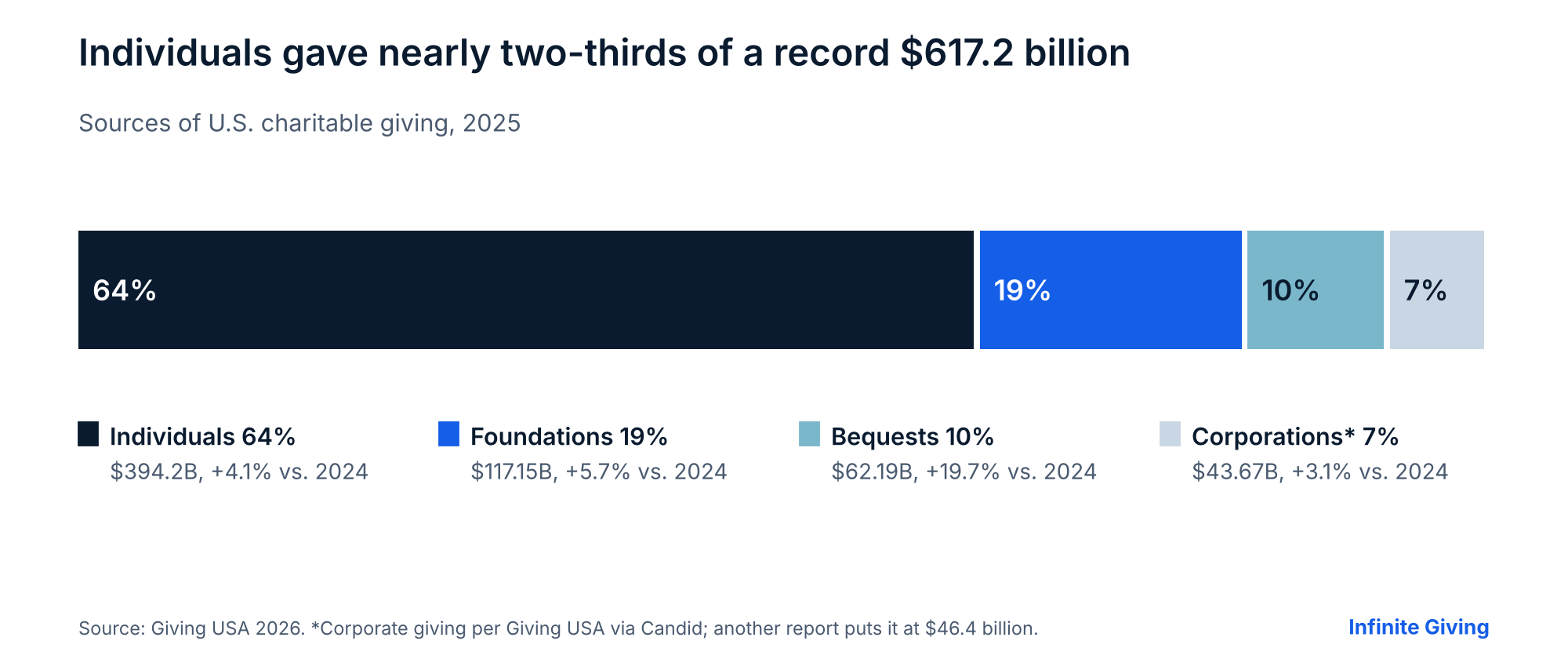
Americans gave a record $617.2 billion in 2025, the first year above $600 billion. That's up 5.7%, or 3.0% after inflation. Bequests rose 19.7% and accounted for about a third of the increase.
New tax rules taking effect in 2026 may change how donors give:
- Non-itemizer deduction: donors who don't itemize can deduct up to $1,000 (single) or $2,000 (married filing jointly) in cash gifts. Gifts to donor-advised funds (DAFs) and gifts of stock don't qualify.
- 0.5% of AGI floor: itemizers can deduct only giving above 0.5% of adjusted gross income.
- 35% cap for the top bracket: itemized deductions are worth 35 cents per dollar rather than 37 for top-bracket donors.
- Corporate 1% floor: corporations can deduct only contributions above 1% of taxable income.
For development teams, these rules may encourage higher-income donors to "bunch" gifts into fewer years and give appreciated stock through DAFs, while small cash donors gain a new incentive. Non-cash assets such as stock already made up 69% of Fidelity Charitable contributions in 2025, so being ready to accept these gifts matters. The Fundraising Effectiveness Project also warns that the second half of 2026 "could prove tougher" because some gifts were pulled forward into 2025.
Questions to bring to your board
These are general considerations, not recommendations for any specific organization. The right response depends on your IPS, cash flow, time horizon, risk tolerance and mission.
- Are our allocations still in line with policy targets? With stocks up 12.7% this year and bonds down, many balanced portfolios may have drifted toward stocks.
- Do our reserves match the time horizons of the programs they support? Separating operating liquidity from longer-dated reserves can balance access to cash with more predictable income.
- Do we understand the interest rate and credit risk in our bond holdings? Q3 showed how differently bonds respond to rising rates.
- Are we staying disciplined with long-term stock holdings? Elevated concentration and valuations argue for diversification rather than market timing.
- Are we ready for 2026 giving under the new tax rules? Consider readiness for noncash gifts, conservative budget assumptions for late 2026 and a stress test for changes in government funding.
It also helps to keep perspective. Since 1980, the S&P 500 has had an average decline of 14.2% within a calendar year, yet it ended with a positive price return in 35 of those 46 years.
Dates to watch
- October 28: FOMC rate decision
- October 29: Q3 GDP and September PCE inflation
- November 6: October jobs report
- December: final FOMC meeting of 2026
We're here to help
Markets will move. Your mission doesn't change. As your fiduciary partner, Infinite Giving helps nonprofit teams make steady, well-informed decisions with the resources entrusted to them, so you can stay focused on the work only you can do.
Want to walk your board or finance committee through these questions?
Get started now by scheduling an introductory call with your fiduciary team.