

If your nonprofit is worried about economic uncertainty, you’re not alone. According to CEP’s 2026 State of Nonprofits Report, some of the top challenges nonprofits face are an unpredictable fundraising environment and concerns about financial stability.
As the sector continues to face uncertainty, how can your organization respond? What steps can you take to reassure donors while strategically shoring up your nonprofit’s finances?
Raising funds is just the start. To help your nonprofit continue delivering its mission during tough economic or political times, consider creating a strategic plan to manage and steward your existing resources. In this guide, we’ll explore tips for strengthening your financial foundation and confidently fundraising during uncertainty.

Key Considerations for Fundraising During Economic or Political Uncertainty
First, take stock of how you currently manage your nonprofit’s funds. Knowing where your organization stands financially is the first step to safeguarding it during potentially turbulent times.
Ask yourself the following questions to get a better picture of your current situation:
- Do you have a reserve fund?
- How much funding do you have in reserve, and where are these funds kept?
- How diverse are your revenue streams?
- What kind of bank accounts does your organization use?
- Is all your funding covered by the FDIC in case of a bank failure?
- Do you have an investment policy?
- Is your board aligned on long-term financial plans?
Don’t worry if you can’t answer all of these questions or if you notice clear gaps in your financial strategy. Start improving your financial practices by implementing these best practices for an uncertain or rapidly changing economy.
Fundraising Strategies for Uncertain Times
Be Transparent with Your Donor Community
Economic uncertainty often affects your donors just as much as it impacts your organization. It’s likely that many supporters are concerned about their own finances, while others want to know how they can provide additional support for your programs as the need for your services increases.
No matter where individual donors stand, they want your organization to be honest. Publicly acknowledge your nonprofit’s financial situation and the challenges you face in fundraising during uncertainty. Inspire trust through transparency by highlighting your financial foundation, immediate needs, and plans to continue delivering your mission.
Additionally, take time to talk with major donors one-on-one to address any personal concerns they have. These donors have committed significant time and resources to your organization, so they expect to be kept in the loop, even when times are hard.
Prioritize Strategic Cash Management
Typically, effective financial management includes practices such as budgeting, accurate reporting, and responsible financial policies. However, one of the most important aspects of managing your funds during times of uncertainty is strategic, long-term financial planning.

Financial planning goes beyond allocating donations to various programs and operational expenses. It involves making strategic decisions about where your funds are held, how they’re tracked, and how you manage different reserves.
Your long-term strategy may include:
- Healthy reserve funds: Any amount of funding you have in reserve can help you weather difficult times. However, remember that unexpected challenges can arise at any time, and aim to keep 6-12 months of your operating expenses in reserve to prepare for ongoing uncertainty.
- Low-risk, highly liquid assets: Traditional savings accounts often yield low returns, which can leave your reserve funds vulnerable to inflation. Instead, consider investing your short-term reserves in low-risk, highly liquid assets like treasury bills or money market accounts.
- Tiered investment strategies: Tailor your long-term cash management strategies to account for different needs and timeframes. For example, you might keep your operating reserves in short-term treasuries, while investing a mid-term capital reserve fund in diversified fixed income portfolios.
By proactively managing your cash and assets, you can build greater financial resilience to help you weather economic downturns. If you’re interested in professional support, consider working with a nonprofit investment advisor who can offer personalized strategies that align with your goals.
.png)
Cultivate Non-Cash Gifts
During periods of economic uncertainty, you may receive fewer small-dollar donations as individuals struggle with their own finances. That’s why many organizations prioritize major donors who are more financially insulated. However, your regular asks may not be enough. Instead, consider exploring new, mutually beneficial ways to engage these donors.
With an increasing number of wealthy donors favoring non-traditional, tax-advantaged giving methods, nonprofits that ask for assets can raise 55% more than those that only ask for cash. Just consider the data in our 2026 State of Nonprofit Asset Gifts Report:
- The average stock donation processed by Infinite Giving in 2025 was over $32,000.
- The average crypto donation was over $11,800.
To tap into this fundraising potential for your nonprofit, start by accepting these core types of non-cash gifts:
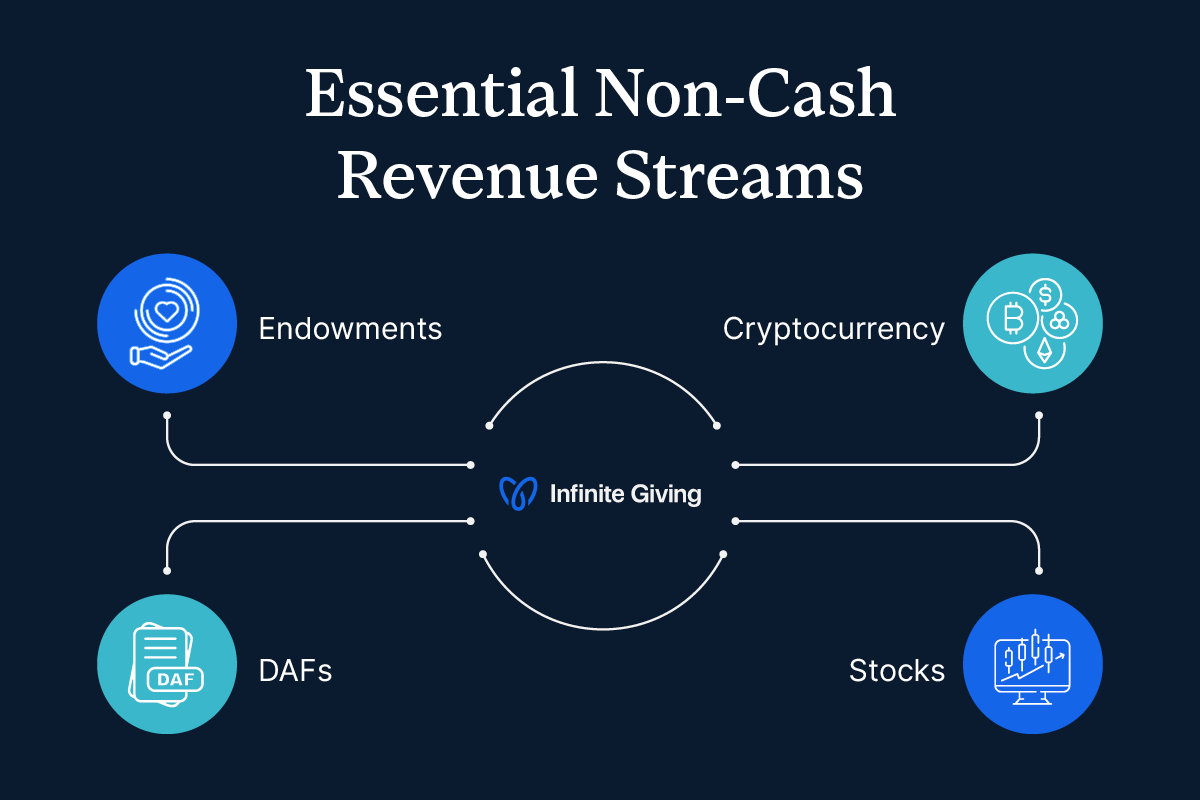
- Cryptocurrency: Some of your supporters may hold cryptocurrencies like Bitcoin or Ethereum and want to donate them to take advantage of potential tax benefits. You can receive substantial gifts while reducing exposure to market volatility by accepting these gifts and promptly liquidating, subject to execution and timing risks.
- Donor advised fund (DAF) grants: DAFs are an increasingly popular way for donors to set aside assets for charitable giving while receiving immediate tax benefits. Promoting DAFs and providing clear instructions for making a grant request can help unlock significant gifts for your nonprofit.
- Stock donations: By donating appreciated stock, donors can potentially avoid capital gains taxes and receive a tax deduction based on the stock’s value at the time of donation. Infinite Giving’s donation platform makes it easy for your donors to give stock by simplifying the process and automatically liquidating stock gifts.
Once you have the infrastructure in place, promote these giving options across your website and other communication channels. Include information about non-cash giving on your donation page, and proactively reach out to any major donors you think might be interested.
Tap into Corporate Giving Opportunities
During times of economic uncertainty, corporate giving can provide a reliable source of funding. Businesses recognize the importance of supporting causes that align with their values, and many continue to prioritize their philanthropic efforts as public needs increase.
Review your list of current and past business connections to look for new opportunities. See if any of them offer corporate giving programs like:
- Matching gifts: Encourage donors to check if their employers offer matching gift programs. When companies match their employees’ donations at a 1:1 or 2:1, your nonprofit can receive much larger total contributions.
- Volunteer grants: For donors unable to give financially, let them know their volunteer hours could result in corporate donations. Many companies offer volunteer grants, contributing a financial donation based on the number of hours their employees volunteer with a nonprofit.
- Corporate sponsorships and grants: When you cultivate relationships with companies that align with your mission, they may be willing to sponsor your next event or provide grants to support specific programs.
Corporate giving partnerships can lead to sustained funding and long-term relationships that benefit both your nonprofit and the company.
Additional Resources for Fundraising During Uncertainty
Navigating economic uncertainty requires thoughtful planning and a willingness to explore new opportunities. By implementing these strategies, your nonprofit can build up its resources and feel better equipped to weather any financial storm.
Looking for more financial planning resources? Check out these guides from the Infinite Giving team:
- What is Fundraising Stewardship? Basics for Nonprofits. Discover the basics of financial stewardship and how you can set your nonprofit up for long-term sustainability.
- Working with Nonprofit Investment Advisors: FAQs & Tips. Learn how professional cash management support from fiduciary advisors can help you build more financial resilience, now and in the future.
- Financial Sustainability Guide for Nonprofit Organizations. Explore more strategies for proactively managing your finances and build your own sustainability plan.

*DISCLOSURE
Infinite Giving Advisory Services, Inc. is an SEC registered investment adviser. Advisory services are only offered to clients or prospective clients where Infinite Giving Advisory Services, Inc. and its representatives are properly licensed or exempt from licensure. This content is solely for informational purposes. Past performance is no guarantee of future returns.
Investors’ experiences may vary from the content. Nothing in this presentation constitutes investment advice, performance data, or any recommendation that any particular security, portfolio of securities, transaction, or investment strategy is suitable for any specific person. Any mention of a particular security and related performance data is not a recommendation to buy or sell that security. Infinite Giving manages its clients’ accounts using a variety of investment techniques and strategies, which are not necessarily discussed in the commentary.
Individualized responses to persons that involve either the effecting of transactions in securities, or the rendering of personalized investment advice for compensation, will not be made without registration or exemption. Investing involves risk and possible loss of principal capital. No advice may be rendered by Infinite Giving Advisory Services, Inc. unless a client service agreement is in place. Donation services provided by Infinite Giving Technologies, Inc.
The information, opinions, and views expressed in this material are provided as of the date indicated and are subject to change without notice. No obligation is undertaken to update or revise this material to reflect events or circumstances occurring after the initial publication date.