

Proactive budgeting grounded in real financial data can help your nonprofit understand its financial resources, needs, and challenges. Once you have this baseline understanding, your organization can start planning responsible cash management strategies that set you up for long-term sustainability.
But first, get up to speed on the basics of budgeting. In this guide, we’ll discuss what goes into a nonprofit operating budget and how to start building yours. We’ll cover:
- What Is an Operating Budget for a Nonprofit?
- What’s Included in a Nonprofit Operating Budget?
- How to Create a Nonprofit Operating Budget
- Sample Nonprofit Operating Budget: Expense Calculator
- Bonus Nonprofit Budgeting Tips

What Is an Operating Budget for a Nonprofit?
A nonprofit operating budget is a document that outlines an organization’s expected revenue and expenses for one calendar or fiscal year. Nonprofits build their operating budgets using historical financial data, planned fundraisers, and confirmed grants to predict how much the organization will earn and spend in the upcoming year.
Regularly compiling and updating your nonprofit’s operating budget is a staple of responsible financial management, as organizations typically use these projections to guide financial decisions throughout the year.
What’s Included in a Nonprofit Operating Budget?
Ideally, you’ll include all of your nonprofit’s projected annual expenses and revenue for the year.
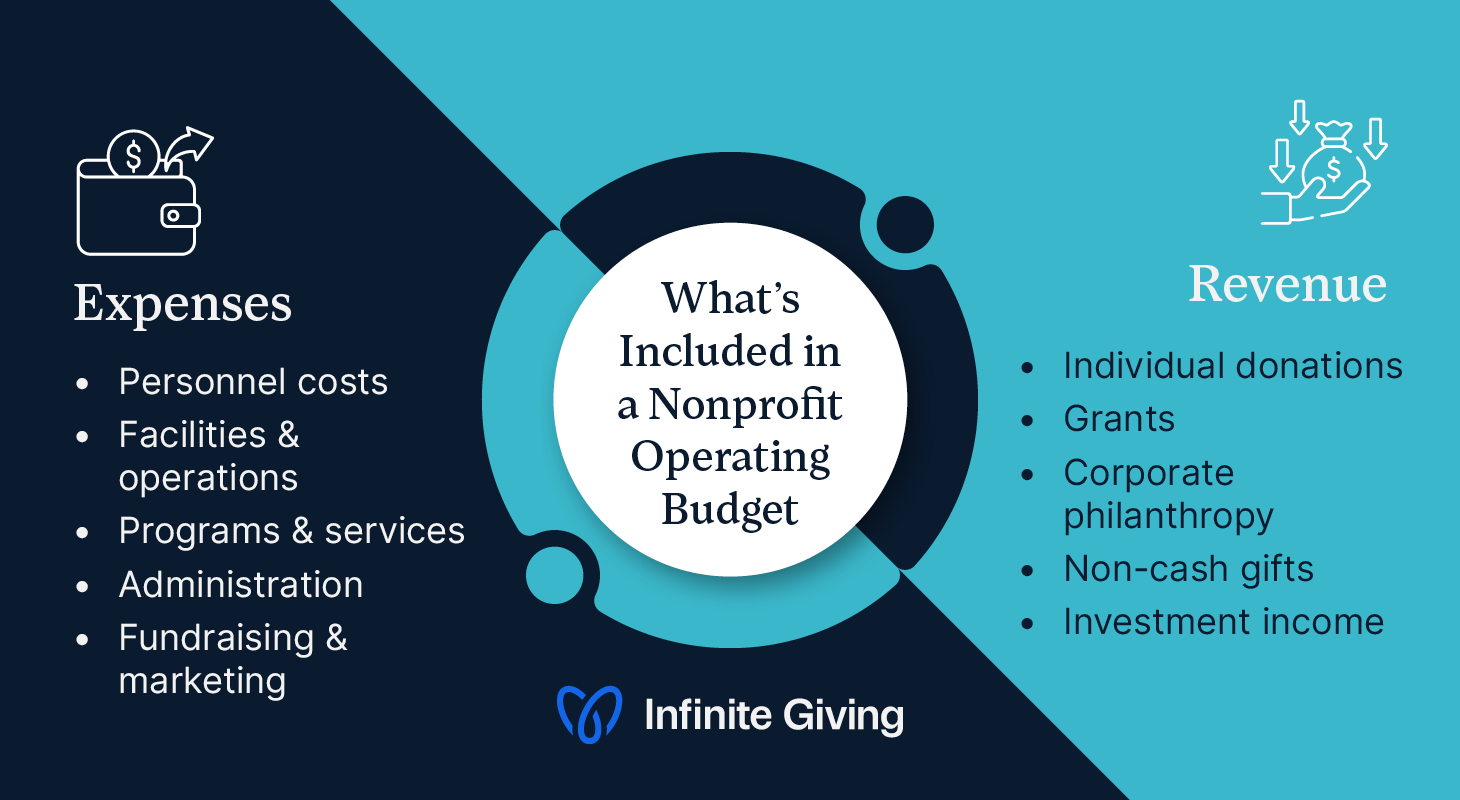
Nonprofit operating budgets break down your organization’s annual finances into two main categories:
1. Expenses
Record all projected expenses for the year, organized by type of expense. Common expense categories you might have in your budget include:
- Personnel costs: Salaries and other staff compensation, employee benefits, payroll taxes, staff training, outsourced services (like consulting costs)
- Facilities and operations: Rent or mortgage for your office(s), utility bills, office supplies, insurance
- Programs and services: Direct program expenses, venue rentals, materials, events, program management software
- Administration: The cost of accounting, legal services, software licenses
- Fundraising and marketing: Campaign materials, postage, fundraising event costs, donor stewardship efforts
2. Revenue
List all of your projected revenue, broken down by revenue source. Include the following core categories, plus any additional income streams:
- Individual donations: Annual contributions, pledged major gifts, recurring donations, fundraising event revenue, online giving, membership dues, product fundraiser sales
- Grants: Foundation or government grants your organization has already won or is expected to win in the coming year
- Corporate philanthropy: Corporate grants, event sponsorships, matching gift revenue, volunteer grants
- Non-cash gifts: Legacy gifts like bequests, asset donations like stocks and cryptocurrency, specialized individual donations like donor-advised fund (DAF) grants
- Investment income: Annual distributions from any large or small endowments, income from investment portfolios, potential returns from investing your reserve funds
We’ll discuss non-cash asset gifts in more detail later, since this type of donation revenue is growing in popularity for many nonprofits. If you plan to include non-cash giving in your operating budget, keep in mind that you may need specialized gift acceptance tools.
For nonprofits that want to streamline non-cash giving for their donors and boost revenue from this channel, Infinite Giving offers an all-in-one donation page that simplifies the acceptance of stock, crypto, DAF, and endowment gifts. Whichever tools you use, remember to include the cost of your non-cash giving infrastructure in the administration or fundraising expense sections of your nonprofit operating budget.

How to Create a Nonprofit Operating Budget
Now that you know what goes into an operating budget, let’s walk through the steps of creating one for your nonprofit.
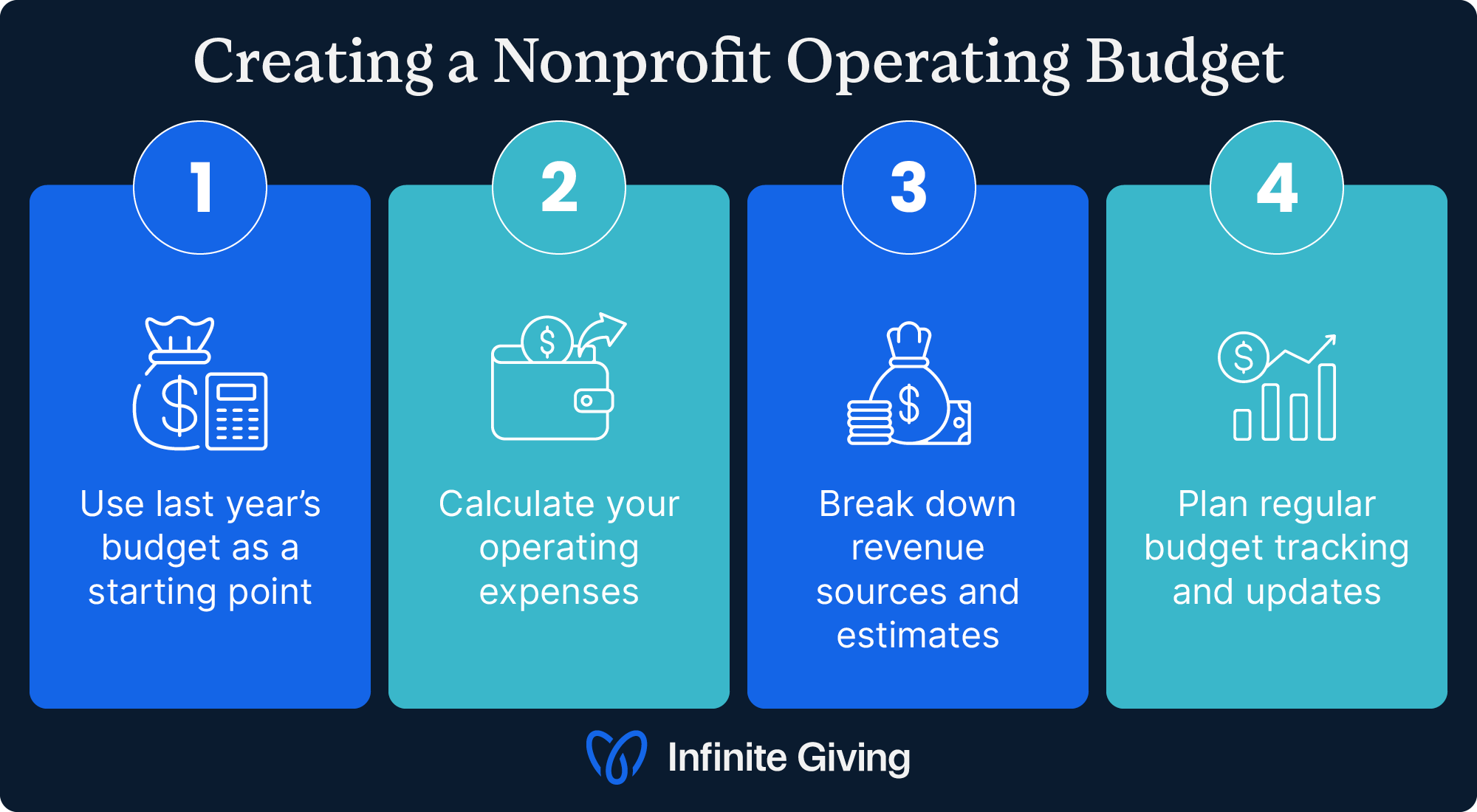
1. Use last year’s budget as a starting point
Ground your budget in reality by starting with the financial data you already have. Take a look at last year’s budgets, monthly financial statements, and official Form 990 filing to see exactly how much you earned and spent compared to your original expectations. Referencing this data as you compile your new operating budget provides essential context for your projections.
2. Calculate your operating expenses
Based on your historical financial data, list all of your annual operating expenses, including overhead costs and goals for organizational savings. Estimate the monthly cost of each expense category, then use our free calculator to determine your overall annual expenses, target reserve funds, and cash runway.
Including your cash runway and a goal for your rainy day fund in your nonprofit’s operating budget helps you stay prepared for unexpected costs or revenue shortfalls. Your cash runway tells you how many months’ worth of expenses you could currently cover, while your target reserves provide a goal to increase your financial stability.
3. Break down revenue sources and estimates
Next, list each of your planned revenue streams and estimate how much you expect to earn from each one. Reference last year’s data to make these projections, along with your existing plans for new fundraisers and revenue sources. For example, if the quiet phase of your capital campaign starts this year, you may raise significantly more from individual major donors than you did last year.
4. Plan regular budget tracking and updates
Finally, prepare to check in with your operating budget and make updates regularly. Update your projections throughout the year as you receive more concrete financial data, and implement internal controls like ongoing board oversight and monthly adjustments based on bank statement reconciliations.
Additionally, consider any smaller budgets you may need to create for specific efforts, such as a detailed event budget for your annual gala and individual program budgets. Determine who is responsible for each of these budgets and when you’ll compile them.
Sample Nonprofit Operating Budget: Expense Calculator
To help you build your operating budget and build in future-thinking cash management strategies, use our free operating expense calculator:
Bonus Nonprofit Budgeting Tips
Include Reserve Funds in Your Operating Budget
As mentioned above, proactively including reserve funds in your budget helps you prepare for your organization’s future. Rather than just planning for the year ahead, building out your reserve funds promotes long-term financial stewardship.
Set a target for your reserves that you can work toward throughout the year, such as 6 months’ worth of operating expenses, or a longer 10-year investment of your nonprofit’s reserve funds. This is especially important if you have a tiered financial strategy with multiple reserve funds and want to calculate the potential impact. For example, you might have:

- Short-term reserves that are highly liquid so you can access them as needed if a grant falls through or the economy shifts.
- Mid-term reserves to save up for a capital campaign or target moderate investment returns.
- Long-term reserves like endowments that are fully invested to maximize future returns.
This approach helps you determine where and how to invest each fund, depending on its purpose and how soon you might need access to the funds.
.png)
Consider Income from Investments & Non-Cash Gifts
If you have the infrastructure to support non-cash gift acceptance and strategic cash management, include projected income from these sources in your nonprofit operating budget.
For example, you might break down asset donations by type (stocks, DAF grants, cryptocurrency, bequests, etc.) and treat them as separate revenue categories. This encourages your team to prioritize cultivating these high-value gifts.
Partner with a Fiduciary Advisor for Cash Management Support
You may discover new opportunities or gaps in your financial strategy throughout the budgeting process. For help addressing these opportunities, consider partnering with a professional who can support your nonprofit’s long-term financial goals and drive organizational sustainability.
Registered Investment Advisors (RIAs) who specialize in nonprofit support can provide valuable services and resources, such as:
- General cash management strategies and support
- Fiduciary insight and financial guidance
- Tools for accepting non-cash donations
- Investment and endowment policy creation
- Diversified investment portfolio management
- Regular reports and financial statements for your board
Infinite Giving provides all of these services and more to help nonprofits of all sizes improve their financial sustainability. Contact our team of fiduciary advisors today if you want help maximizing reserves, accepting asset donations, or just refining your long-term financial strategies.
More Nonprofit Financial Resources for Beginners
Budgeting is just the beginning of responsible financial management. Learn more about the basics of nonprofit finance and how you can take your organization’s strategy to the next level by checking out these resources:
- The Basics of Nonprofit Financial Management: Start Here. Get your questions answered and brush up on nonprofit finance essentials like budgeting, reporting, financial planning, and policy development.
- 14 Revenue Streams for Nonprofits & How to Diversify Yours. Dive deeper into revenue diversification and why it matters for nonprofits. Explore common revenue streams and how to tap into each one.
- Internal Financial Controls for Nonprofits: Checklist Guide. Learn more about internal controls and how these policies help to safeguard your nonprofit’s funding.

*DISCLOSURE
Infinite Giving Advisory Services, Inc. is an SEC registered investment adviser. Advisory services are only offered to clients or prospective clients where Infinite Giving Advisory Services, Inc. and its representatives are properly licensed or exempt from licensure. This content is solely for informational purposes. Past performance is no guarantee of future returns.
Investors’ experiences may vary from the content. Nothing in this presentation constitutes investment advice, performance data, or any recommendation that any particular security, portfolio of securities, transaction, or investment strategy is suitable for any specific person. Any mention of a particular security and related performance data is not a recommendation to buy or sell that security. Infinite Giving manages its clients’ accounts using a variety of investment techniques and strategies, which are not necessarily discussed in the commentary.
Individualized responses to persons that involve either the effecting of transactions in securities, or the rendering of personalized investment advice for compensation, will not be made without registration or exemption. Investing involves risk and possible loss of principal capital. No advice may be rendered by Infinite Giving Advisory Services, Inc. unless a client service agreement is in place. Donation services provided by Infinite Giving Technologies, Inc.
The information, opinions, and views expressed in this material are provided as of the date indicated and are subject to change without notice. No obligation is undertaken to update or revise this material to reflect events or circumstances occurring after the initial publication date.