With slowed economic growth, recent years have been turbulent for nonprofit fundraising. If your nonprofit has experienced a funding shortfall from a previously reliable income source, that’s your signal to start diversifying your revenue streams.
From grants to merchandise sales to endowments to cryptocurrency, there are more revenue streams for nonprofits than your organization might assume. To help your nonprofit find stability in these uncertain times, we’ll review top revenue streams and how your organization can tap into them. Specifically, we’ll cover:
- Diversifying Revenue Streams Worksheet
- The Importance of Diverse Revenue Streams for Nonprofits
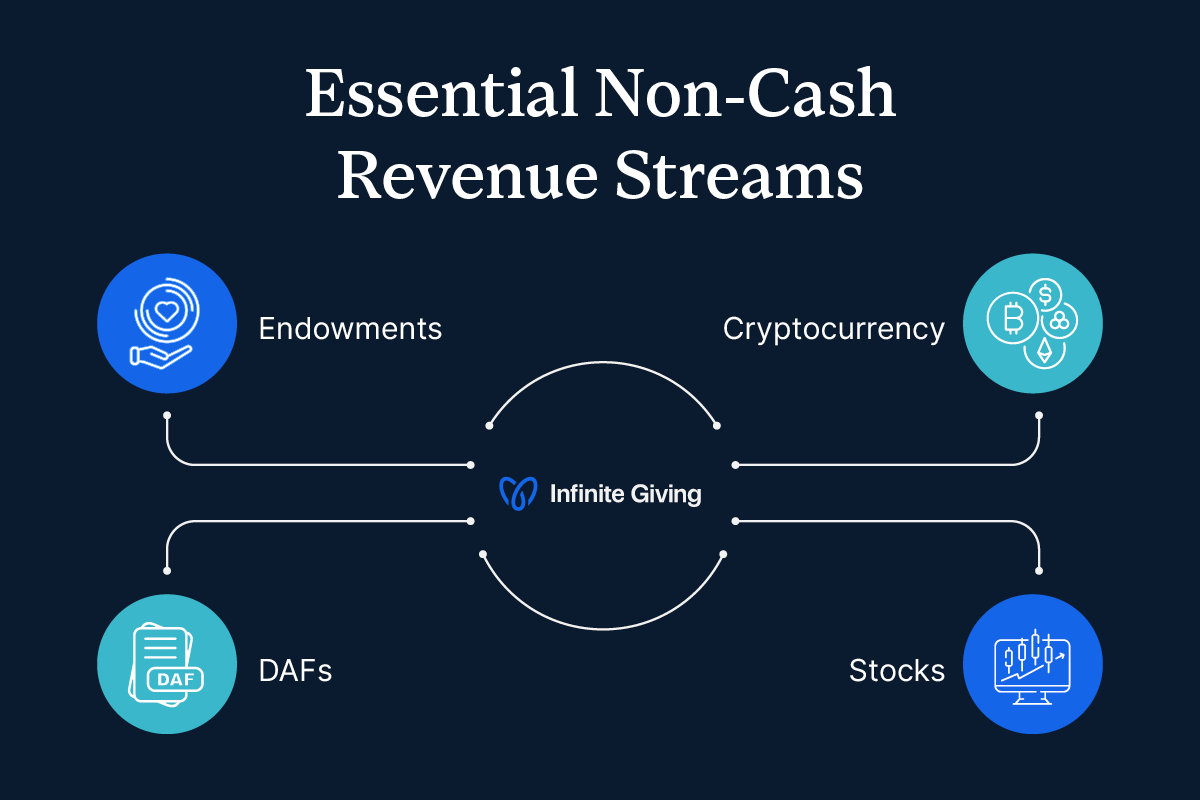
- Essential Non-Cash Revenue Streams for Nonprofits
- 10 Other Nonprofit Revenue Streams to Consider
- How to Diversify Your Nonprofit’s Revenue Streams
While your nonprofit might not be able to immediately access all of these revenue streams, the more funding sources you can secure, the more sustainable your nonprofit’s finances will be moving forward.

Diversifying Revenue Streams Worksheet
Before we dive in, take some time to think about your organization’s current revenue streams and goals. Use our worksheet to get a snapshot of your current revenue diversification and make plans for growth.
The Importance of Diverse Revenue Streams for Nonprofits
Diversified revenue isn’t just a nice-to-have safety net but a core tenet of responsible nonprofit financial management. Even in economically sound times, it’s possible for nonprofits to suddenly lose sources of revenue, whether it’s a grant not renewing or a major donor reducing their gift amount. In common scenarios like these, nonprofits that rely too heavily on any one funding source can find themselves struggling to stay afloat.
In addition to increasing your resiliency, diverse revenue streams provide your nonprofit with:
- Risk protection. When your nonprofit has multiple revenue streams you can count on, you’re less exposed to risk. This also allows you to take strategic risks, knowing you have other funding sources as a cushion. For example, if your nonprofit has steady income from donations and service fees, you might experiment with setting cash aside to start an endowment fund, knowing your organization can tolerate reduced liquidity.
- Improved sustainability. While financial stability refers to short-term success and self-sufficiency, sustainability covers your ongoing efforts to maintain long-term financial health. For instance, expanding your grant-seeking strategies now is unlikely to provide immediate financial relief. However, several months down the line, you’ll have new income that can support your programs for years to come.
- New funding partners. When you expand your income sources, you’ll come into contact with new partners and audiences that want to support your nonprofit. An emergency donation from a corporate partner to weather economic turbulence today might lead to an event sponsorship the following year.
To access these benefits, your nonprofit needs the right infrastructure to diversify income sources. In particular, this means creating pathways for accepting and processing non-cash donations, which have seen a 135% growth in charitable contributions over the past decade.
Essential Non-Cash Revenue Streams for Nonprofits
With the growing prominence of non-cash donations, your nonprofit should familiarize itself with these vital revenue streams:
Cryptocurrency
If you’ve followed financial news over the past years, you’ve likely heard of Bitcoin and Ethereum before. These and other cryptocurrencies are digital currencies. Rather than being issued or regulated by a government entity like fiat currencies are, cryptocurrencies are minted and transferred entirely online.
The deregulated nature of cryptocurrency comes with risks but also potential rewards. Particularly, cryptocurrencies are popular because anyone in the world can buy in at any time, allowing investors of all sizes to purchase and sell their cryptocurrencies at will.
However, it’s important to note that cryptocurrencies cannot be spent on goods and services. For instance, your nonprofit cannot use Bitcoin to pay employees or purchase program supplies. Additionally, you cannot simply accept a Bitcoin donation through your nonprofit’s bank account.
To accept cryptocurrency donations, you’ll need a platform that can:
- Receive cryptocurrency donations. Cryptocurrency is stored in a user’s online wallet, which is a digital tool designed to receive and send cryptocurrency. Your cryptocurrency donation platform will create a wallet for your nonprofit so you can easily receive gifts of crypto.
- Convert cryptocurrency into cash. Once a gift is received, the best donation platforms will automatically cash out the cryptocurrency for its cash value.
- Transfer funds to your bank account. After a cryptocurrency has been converted into cash, your donation platform should automatically transfer the funds to your nonprofit’s bank account.
Cryptocurrency is a powerful new revenue stream, but your nonprofit’s leadership may be wary about the risks. Here’s how your nonprofit can avoid a few common concerns:
- Volatility: Cryptocurrency’s value is based on the number of people purchasing it. This means a crypto gift worth $1,000 today might drop to $500 the following week. When you receive a crypto donation, cash it out immediately to lock in its current value.
- Fraud: While no government regulations mean cryptocurrency traders are free to set up their own crypto projects and transfer funds at their own discretion, this also opens crypto investors up to fraud. For the most part, fraud and scams impact individuals buying cryptocurrency rather than a nonprofit receiving gifts. Additionally, your crypto donation platform should help you spot and avoid suspicious transactions.
- Data privacy: Cryptocurrency transactions are facilitated through the blockchain, which is a set of data blocks that cannot be edited or deleted after they are created. To make a crypto transaction, users have to share their digital wallet’s ID code with the blockchain. This means individual donors’ gifts can be traced back to their wallets, and neither they nor your nonprofit can keep this information private. Ensure your cryptocurrency acceptance page includes a statement about privacy so all donors are aware of this concern.
.png)
Stocks
Just like individual traders, nonprofits can also receive and sell stocks.
For some stock traders, donating stock to a nonprofit is a wise financial decision. Normally, individuals have to pay capital gains tax on appreciated shares when they cash out. However, if a trader donates stock to a nonprofit, they can avoid that tax and receive a tax deduction for their charitable gift.
Nonprofits can accept stock donations in two easy steps:
- Open a brokerage account. A brokerage account allows you to manage your nonprofit’s stock holdings. To simplify this process and avoid the hassle of managing this account yourself, partner with a stock donation platform provider like Infinite Giving. Provide your nonprofit’s contact information, tax identification number, and copies of your 501(c)(3) IRS Determination Letter and Articles of Incorporation, and Infinite Giving will set up a brokerage account for you (much faster than a traditional bank would!).
- Share your stock donation link with donors. Once your account is open, Infinite Giving will provide a donation link you can embed on your website or share directly with donors through email. Donors who click on the link will be taken to a custom donation page that can process stock donations.
Like cryptocurrency, stocks can be volatile, meaning nonprofits should cash out quickly after receiving a donation. With Infinite Giving, liquidation happens automatically to preserve the stock’s value at the time of donation.
DAFs
Donor-advised funds (DAFs) are a vast untapped revenue source, with an estimated $250 billion stored in these accounts.
Essentially, DAFs are charitable giving accounts created for individual donors or organizations. The donor contributes to the fund and acts as an advisor for how and when the funds should be spent, but it’s ultimately managed by the sponsoring organization.
Think of DAFs as the middlemen between nonprofits and donors. Donors receive tax deductions when they contribute to the DAF and can store their wealth there as long as they want, as there are currently no laws dictating when DAFs must distribute funding.
While DAFs primarily benefit donors, there are a few positives for nonprofits, including:

- More funding. Ultimately, DAF grants are donations meant for nonprofits. When these gifts do arrive in your nonprofit’s bank account, they provide valuable fuel for your mission.
- Access to major donors. While anyone can open a DAF, they are most commonly used by wealthy individuals. This means if you receive a gift from a DAF, you also get a new major giving candidate.
- New revenue stream. By getting your nonprofit on DAF holders’ radar, you can receive a steady flow of gifts from these organizations.
Donors who use DAFs can request a contribution to your nonprofit at any time. However, they’re not incentivised to do so, so it’s up to your nonprofit to seek out these donations. Encourage gifts by promoting DAF giving, educating supporters about DAFs, and leveraging a DAF giving widget that streamlines the donation request process.
Endowments
Endowments are investment accounts that provide long-term revenue by generating investment income. The initial principal and subsequent gifts are meant to stay in the endowment and grow over time, while a small percentage (typically 4-5%) gets disbursed to your nonprofit each year.
Some nonprofits may assume they’re too small to start an endowment, but in reality, nonprofits of any size can launch one if they have the right strategy. A few types of endowments small nonprofits should aim to create include:
- Quasi-endowments are created via the nonprofit’s internal funds. As your nonprofit creates this endowment internally, it can be dissolved at any time. Nonprofits that are unsure how their long-term needs will change can especially benefit from quasi-endowments.
- Micro-endowments are small endowments. Typically, an endowment should be twice your annual budget. However, this amount might be unfeasible for small nonprofits. Through micro-endowments with as little as a few thousand dollars, your nonprofit can still earn investment revenue and entice donors to contribute to your principal.
- Unrestricted endowments allow nonprofits to spend generated revenue however they wish. Due to this flexibility, many types of nonprofits try to build this type of endowment when possible.
Endowments aren’t the right fit for every organization, so consider the impacts carefully before committing to one. For instance, endowments are a long-term investment in your nonprofit’s financial future and won’t produce significant revenue upfront. In fact, a brand new investment may even reduce your cash on hand due to its lack of liquidity.
If you’ve weighed the pros and cons and have decided that an endowment is the right choice for your nonprofit, start working with a nonprofit financial advisor to help you create and manage your endowment.
Easily Accept Non-Cash Gifts with Infinite Giving
Non-cash donations can dramatically improve your nonprofit’s fundraising potential, allowing you to connect with new donors, source major gifts, and increase your revenue streams.
However, every type of non-cash gift requires specialized infrastructure for your nonprofit to accept and access. Fortunately, Infinite Giving is a comprehensive non-cash donation management platform that allows nonprofits to accept stock, crypto, DAF grants, and endowment funds with ease.
.png)
Rather than muddying through the process of creating crypto wallets and liquidating gifts yourself, or seeking out separate platforms for each gift type, Infinite Giving is the all-in-one solution that makes handling non-cash donations as simple as accessing any other revenue stream.
To get started, connect with Infinite Giving, explore the platform, and add the specialized widgets to your donation page to make non-cash giving simple for you and your donors.
10 Other Nonprofit Revenue Streams to Consider
Outside of valuable non-cash donations, your organization can improve its financial stability by tapping into these revenue streams for nonprofits.
Cash Donations
Cash donations are monetary gifts made to your nonprofit. Unlike non-cash donations, these can be spent immediately. However, that doesn’t mean cash donations are simple to manage.
To keep your finances organized and maximize revenue, follow cash management best practices like:
- Monitoring your nonprofit’s cash flow
- Creating realistic budgets
- Keeping 6-12 months of cash reserves
- Exploring low-risk, high-liquidity investment strategies
- Working with a nonprofit investment advisor
Fundraising Events
From auctions to galas to community picnics, fundraising events bring your community together to make memories and support your nonprofit. Fundraising events vary widely in how they generate revenue, including methods such as:
- Ticket sales
- Calls for donations throughout the event
- In-event purchasing opportunities
- Food and beverage sales
Recurring Giving
While one-time gifts are always appreciated, supporters who make recurring donations provide revenue your nonprofit can count on. Most recurring gifts are contributed on a monthly basis, though some recurring supporters may give on a quarterly or annual basis.
Encourage recurring gifts by promoting them on your donation page. Most nonprofits add a simple checkbox or button that lets supporters turn their donation into a recurring gift.
Service and Product Fees
Some types of nonprofits generate revenue by selling products or services. The most common examples are educational institutions and hospitals, but animal shelters, nonprofit publishers, and other organizations often have fees for their services.
Additionally, any nonprofit can set up a merchandise store to sell products like:
- T-shirts
- Sweaters
- Tote bags
- Mugs
- Frisbees
- Notebooks
- Calendars
Corporate Sponsorships
Businesses often partner with nonprofits to boost their reputations and get their brand in front of new audiences. Your nonprofit can take advantage of this by connecting with businesses to earn sponsorships.
Typically, corporations will sponsor individual events, but some businesses may be willing to be long-term partners that support a specific program in exchange for continuous recognition, such as featuring their logo on your nonprofit’s website.
Grants
Foundations, corporations, and government organizations all issue grants to nonprofits. Usually, grants are restricted funds that must be spent on a designated project, though some grants have looser requirements or are only temporarily restricted.
To secure grant funding, nonprofits should create a dedicated grant application process that involves:
- Leveraging a grant database to identify relevant grants
- Completing grant applications, including writing compelling grant proposals
- Managing multiple grant deadlines to ensure all applications are submitted on time
Peer-to-Peer Fundraising
Expand your fundraising efforts by recruiting motivated supporters to fundraise on your behalf. This is known as peer-to-peer fundraising and involves individual supporters soliciting donations for your nonprofit from their family, friends, and social media followers.
Peer-to-peer fundraisers require peer-to-peer software, which creates individual pages for each volunteer gathering donations. This way, donors can submit their gift to their loved one rather than a nonprofit they may be unfamiliar with, boosting fundraising potential.
Matching Gifts
Matching gifts are a type of corporate philanthropy where businesses match their employees’ gifts to nonprofit organizations. While every business has its own matching gift criteria, most nonprofits are typically eligible for matching gifts as long as:
- Your nonprofit is a registered 501(c)(3) organization
- Your nonprofit is not a political or religious organization
- Your nonprofit is a reputable organization
You can earn matching gift donations by promoting this opportunity to supporters and encouraging them to look up if their employer offers matching gifts.
Planned Gifts
Planned gifts are donations that supporters pledge to give after their passing. There are several types of planned gifts, but the simplest and most common is bequests.
Bequests are gifts made through a donor’s will with the intention of distributing specified funds after the donor’s death. Due to bequests and many other types of planned gifts requiring legal documents and agreements, ensure you discuss your planned gift program with your nonprofit’s lawyer and advise donors to meet with their legal counsel to compose and verify any relevant documents.
Investment Income
Just like businesses and individuals, nonprofits can invest funds and generate revenue from them. Nonprofits can earn investment income by:
- Investing in stocks
- Purchasing treasure bills
- Buying Certificates of Deposit (CDs)
- Keeping their reserve funds in other low-risk, highly liquid assets
These investment opportunities can help your nonprofit turn the funding it receives from other channels into even more revenue, maximizing your earning potential. However, many nonprofits feel they lack the time or knowledge to make smart investments.
To start investing, work with an investment advisor who specializes in nonprofits. While many investment advisors have large nonprofits as clients, Infinite Giving is one of few firms that works with small and medium-sized nonprofits. Our team of Registered Investment Advisors can provide your nonprofit with:
- Consistent fiduciary oversight
- FDIC coverage up to $5 million in one account
- Tools to grow asset giving
- Quarterly board reports
You can also view all of your nonprofit’s investment activity through our intuitive platform designed just for nonprofits. With our user-friendly investment software and commitment to working in your nonprofit’s best interests, your organization will receive transparent, affordable financial advice when you partner with Infinite Giving.
.png)
How to Diversify Your Nonprofit’s Revenue Streams

1. Evaluate your current revenue distribution
Take inventory of your fundraising practices to understand your current revenue streams and how much you earn from each one. Additionally, consider what types of revenue your nonprofit is equipped to accept.
To get a quick overview of your current revenue distribution status, take our quiz! Completing the quiz can help you start thinking critically about your revenue streams and provide guidance for how to start diversifying.
2. Set initial goals
Once you know what revenue streams you have, consider which new ones you would like to explore. Revenue streams for nonprofits vary in their accessibility, potential return on investment, and immediacy in producing results.
For example, expanding your gift acceptance system to tap into non-cash donations of stock and crypto is a quick win you can set up almost immediately. All you need to do is partner with a provider like Infinite Giving that can process these gifts on your behalf, then start promoting your new giving opportunities to your supporters.
Additionally, set long-term goals, such as networking with businesses to eventually earn sponsorships. Balance short- and long-term efforts to avoid overwhelming your team and ensure each revenue source you pursue is thoroughly developed into a reliable income stream.
3. Partner with nonprofit financial advisors
Not sure where to start when it comes to non-cash revenue streams? A nonprofit investment advisor can provide your nonprofit with the insight you need to tap into these channels and manage them long-term.
When it comes to nonprofit financial excerpts, Infinite Giving is the go-to consulting service for nonprofits of all sizes. When you partner with Infinite Giving, we’ll help you maximize your non-cash revenue streams’ earning potential through our range of services tailored to nonprofits’ needs:
- Unlock non-cash gifts quickly and streamline the process
- Open a brokerage account for you with up to $5 million in FDIC coverage
- Create essential policies for your nonprofit like an IPS
- Manage low-risk, highly liquid investment portfolios
- Put your reserve funds to work
- Report regularly to your board
- Provide intuitive dashboards to track your non-cash gifts and endowment growth

4. Track revenue growth and adjust revenue streams as needed
While you can’t expect immediate results from every new funding stream, keep an eye on your metrics and establish benchmarks for when you should start to see revenue growth. In some cases, you may need to choose new income sources to pursue, which might require a shift in strategy.
For example, if your last few fundraising events only broke even, you might put a pause on large-scale, expensive events until you can find a new strategy that works. In contrast, if you add stock giving to your donation page but receive no stock donations after a month, that might signal that you just need a new marketing strategy to alert supporters about this opportunity.
Leveraging Creative Revenue Streams for Nonprofits
The more revenue streams your nonprofit has, the more stable your organization will be in times of change. However, to earn reliable income from these new sources, you need to understand how they work, how to maximize their value, and whether they fit into your nonprofit’s financial strategy.
To start improving your revenue stream management, leverage the tips in this article to find new funding channels that make sense for your nonprofit. Then, partner with a financial advisor to discuss maximizing your revenue streams of choice.
For more information on how to access and manage high-value income sources, explore these resources:
- How to Develop a Nonprofit Investment Policy and Manage Risk. To start your new investment strategy off on the right foot, learn what an investment policy is and how to create one for your nonprofit.
- Nonprofit Asset Management: Basics, Benefits, & Options. Before making new investments, ensure you understand what assets your nonprofit currently has. Review the basics of asset management to improve your financial strategy.
- Crypto Donation Platform for Nonprofits. Crypto donations can put your nonprofit in touch with a brand new class of investors. Discover how Infinite Giving makes accepting these gifts simple.