When people think of brokerage accounts and investing money, nonprofits typically don’t come to mind. You may not even know that nonprofits can invest funds or why they would. However, many nonprofits do have brokerage accounts, and yours can, too. If your organization wants to improve its cash management and earn more large donations, opening a brokerage account can be an impactful first step.
In this guide, we’ll break down everything you need to know about brokerage accounts for nonprofit organizations, including:
Managing your nonprofit’s finances is a complex process, especially when it involves navigating a type of account you’ve never used before. Let’s dive into the details to help you feel prepared to open a brokerage account for your nonprofit and understand the best options available to your organization.
Nonprofit Brokerage Account FAQ
What is a Brokerage Account?
A nonprofit brokerage account is an investment account that an organization can use to invest funds, receive stock donations, and grow its reserve funds.
Instead of only holding cash like a regular bank account, brokerage accounts can hold stocks, bonds, and mutual funds in addition to cash. These accounts are managed by a brokerage firm, online broker, or other investment advisor that handles the logistics of trading and processing stocks for you.
Can a Nonprofit Have a Brokerage Account?
Yes, nonprofit organizations can open their own brokerage accounts. Not only that, but maintaining a brokerage account is a key practice for helping to grow your nonprofit’s financial sustainability.
While an individual or company may use an investment account to make a profit, the purpose of a nonprofit brokerage account is to have a greater impact by receiving and managing high-capacity gifts for the organization’s cause with the goal of greater financial sustainability. By asking for stock donations and investing in low-risk, highly liquid investment strategies, these non-cash gifts can help to grow your organization’s financial capacity to weather economic changes and devote more to your mission.
Why Do Nonprofits Need Brokerage Accounts?
Ultimately, brokerage accounts help nonprofits effectively steward their finances, promoting organizational stability and longevity.
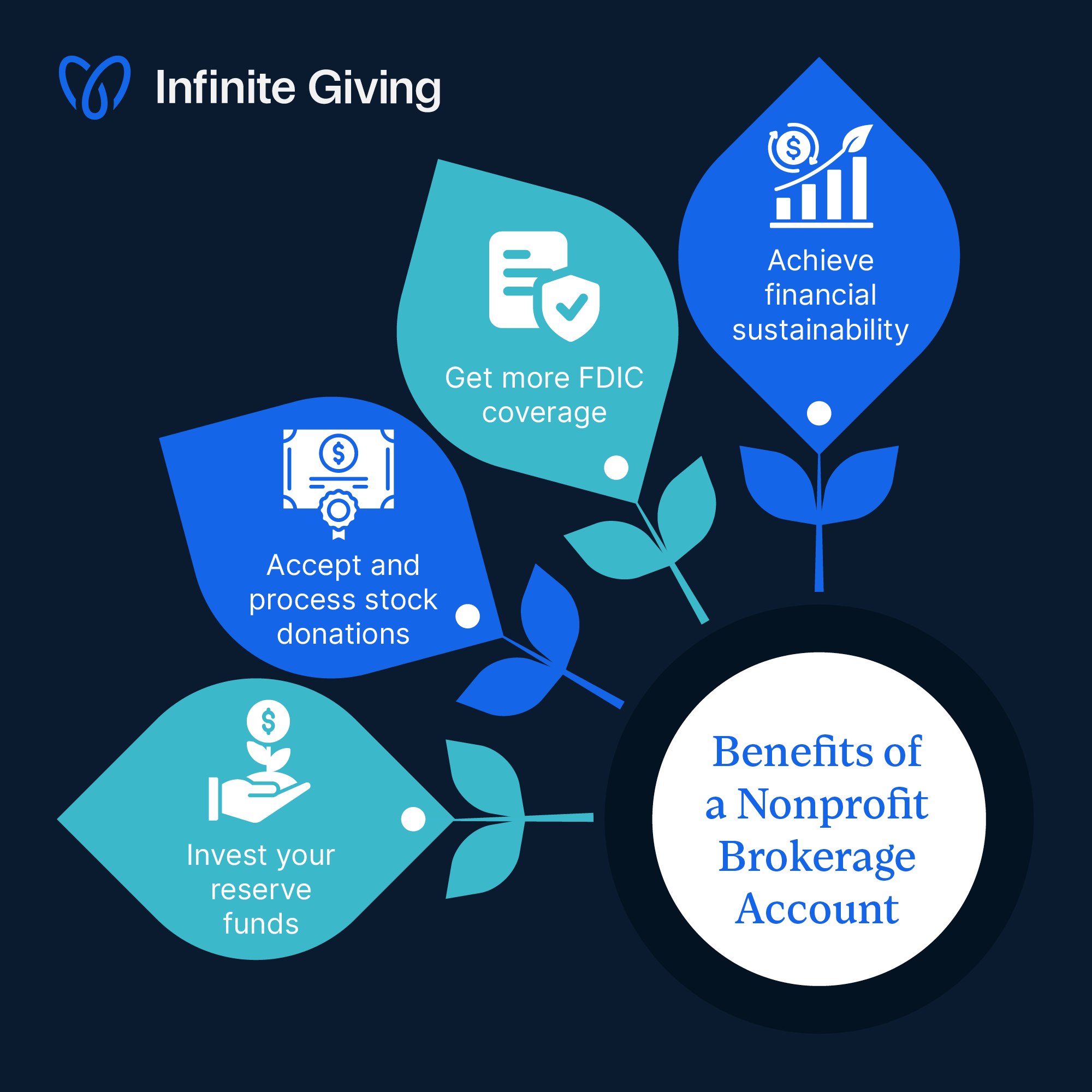
Opening a nonprofit brokerage account comes with many benefits, including giving your organization the ability to:
Invest your reserve funds. The most common draw of opening a brokerage account is the ability to invest funds. For a nonprofit, this means investing your reserve funds in low-risk strategies to give them the chance to grow over time. In comparison, keeping your reserve funds in a savings account alone can cause you to lose money over time due to inflation.
Accept and process stock donations. Donating stocks is highly appealing to donors since they receive additional tax benefits and can end up donating more to your nonprofit than they originally paid for the stock. However, you can’t accept these donations without a brokerage account. Opening one allows you to tap into this up-and-coming donation opportunity and give your donors more ways to support your cause.
Get more FDIC coverage. Having a brokerage account also gives you access to a sweep program for your cash, enabling you to get more FDIC coverage for a single account. With an Infinite Giving account, for example, you can get FDIC coverage for up to $5 million, far above the typical $250,000 max you get with a regular bank account. This means more of your funding is backed by the U.S. government. It also simplifies bookkeeping because you only have to manage one account to retain coverage.
Together, all of these factors can help your organization achieve greater financial sustainability long term.
If you’re excited about investing or improving your cash management with a brokerage account, take time to develop your nonprofit’s Investment Policy Statement (IPS) before you dive in. An IPS outlines specific rules and governance policies you’ll use to manage any investments you make, including stipulations for how donor funds can be used. You can create this document with the help of a nonprofit investment advisor or by using a template like Infinite Giving's free IPS template.
What Assets Can be Held in a Nonprofit Brokerage Account?
Along with cash, brokerage accounts can typically hold stocks, bonds, mutual funds, treasury bills, Certificates of Deposits (CDs), and other cash equivalents. Check with your specific brokerage account provider to verify the assets you can hold.
Are There Fees Associated with Brokerage Accounts?
While most brokers and account providers do not charge a fee to open or maintain a nonprofit brokerage account, other fees may apply. For instance, Infinite Giving does not charge any setup, broker, or admin fees. However, if you use our cash management services, your account may be subject to a 0.65% fee on assets under management (AUM).
How Can My Nonprofit Open a Brokerage Account?
Nonprofits can open brokerage accounts with traditional banks, brokerage firms, or specialized nonprofit investment advisors by submitting an application and moving money into the account. Jump to our how-to section for detailed steps.
What Are the Best Brokerage Accounts for Nonprofits?
Nonprofits have a few options when opening a brokerage account. You can choose a traditional brokerage firm like Fidelity or Schwab, which offer specific nonprofit brokerage accounts alongside their other options. However, these accounts tend to have high minimum balances and more difficult application processes.
To make the process easier, consider working with a nonprofit investment advisor like Infinite Giving instead. These fiduciary partners can open a brokerage account for you in as little as three business days and ensure that it meets your organization’s needs.
How to Open a Brokerage Account for a Nonprofit Organization
Ready to open a brokerage account for your nonprofit? Follow these three steps to get started:
Steps to Open a Brokerage Account
Click each step for a quick snapshot of your options!
Traditional Brokerage Account
Open with a big bank or brokerage firm
Longer, manual processes
No transparency into donor contributions
Nonprofit Investment Advisor
Specialized process designed for nonprofits
Faster, streamlined application process
Automatic stock donation liquidation
You'll need the following:
Your nonprofit's EIN
Articles of Incorporation
Bylaws
A balance minimum
💡TIP
Cut the application process down from weeks to days with Infinite Giving!
There are a variety of firms, banks, advisors, and online platforms that offer brokerage services for nonprofits. However, not every bank and advisory firm works with nonprofits, so be sure to find one that welcomes tax-exempt entities. Do extensive research on any brokers you consider, as you’ll be trusting them to manage large amounts of your organization’s funds.
As you weigh your options, consider important factors like:
Fees
Account minimums
Speed of opening an account, processing stock donations, etc.
Available investment options
Customer support
Nonprofit experience
Accessibility for small and mid-size organizations
To help you make an informed choice, we’ll go deeper into the pros and cons of two main options: going the traditional route and partnering with a specialized nonprofit investment advisor.
Traditional Brokerage Accounts
In the past, most nonprofits’ only option was to open an account with a big bank or brokerage firm. Now, more specialized advisors and platforms exist to help nonprofits open brokerage accounts and manage their funds effectively.
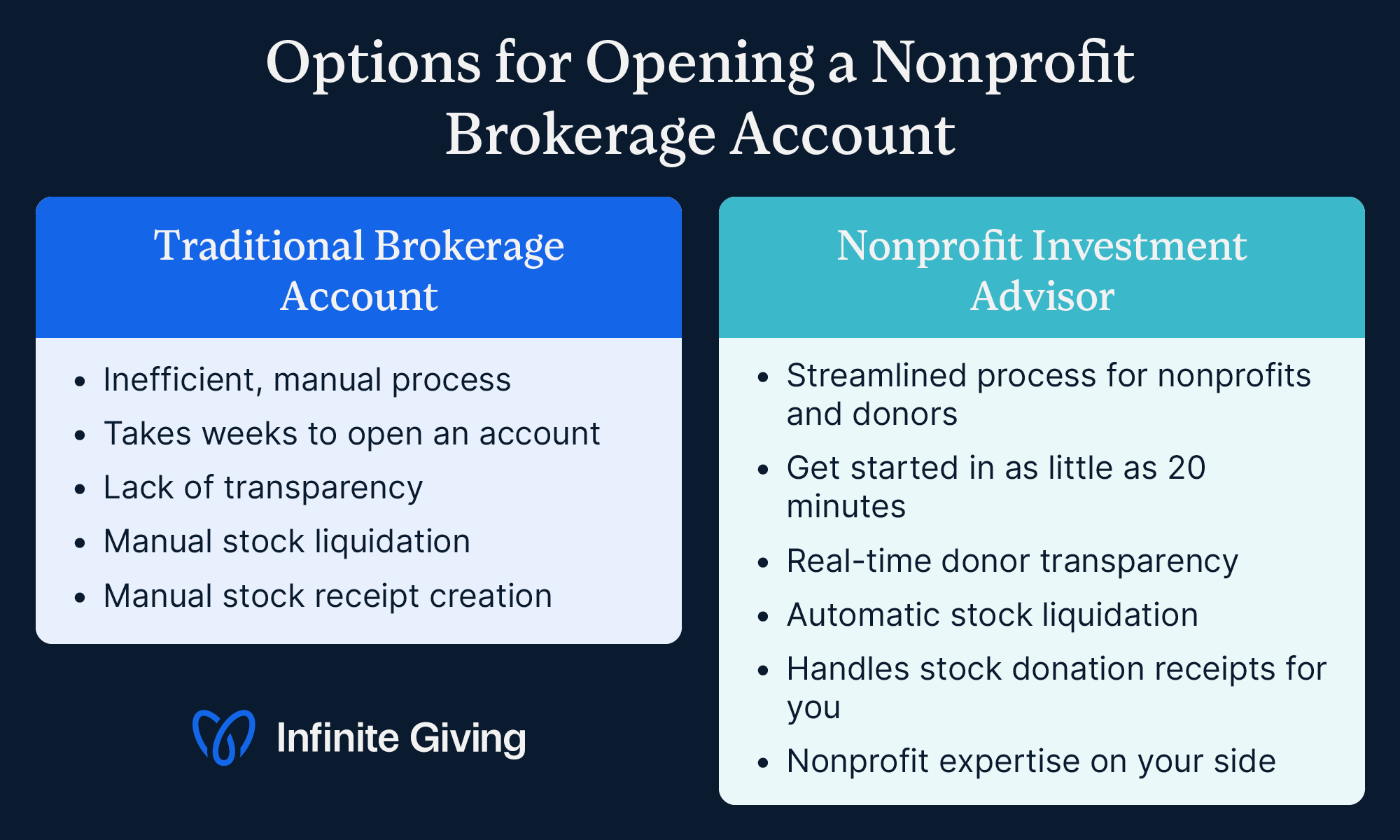
However, you can still choose to open a brokerage account with a traditional brokerage firm like Fidelity or Schwab if you determine that’s the best fit for you. Just keep in mind that this option can come with substantial drawbacks, such as:
Inefficient, manual processes for opening an account and processing stock donations.
Lengthy application and approval timelines.
Lack of transparency into donor contributions.
Manual, time-consuming liquidation processes for stock gifts.
Having to manually create and send stock donation receipts, which is a complex and tedious process.
By working with Infinite Giving, you can access benefits like:
A streamlined process for donors. If you use a traditional brokerage firm, donors who want to gift stock may have to follow a complicated process. Typically, they would call your organization, download a PDF request form, ask their advisor to call your organization, and more. With Infinite Giving, donors can complete the entire stock donation process online in as little as 10 minutes.
Faster application process. Instead of spending ages filling out a lengthy application and then waiting weeks for approval, you can apply for an account with Infinite Giving in as little as 30 minutes and open a nonprofit brokerage account in just three business days.
Real-time donor transparency. Most traditional brokerage accounts don’t give your organization the names of any stock donors, causing you to miss out on valuable opportunities for donor stewardship. Infinite Giving, however, gives you complete, real-time transparency into all stock donations you receive. See everything from an intuitive dashboard so you can make the most of every connection opportunity.
Automatic stock donation liquidation. Infinite Giving’s stock donation tools allow your nonprofit to accept stock gifts (and DAFs and crypto!) online and automatically liquidate them to cash so you don’t have to worry about fluctuating value. With a traditional firm, you would have to manually request liquidation every time you want to convert a donation to cash.
Branded donation receipts. Stock donation receipts aren’t the same as the receipts you give for cash contributions. You can’t list a dollar amount; instead, provide the stock identifier, number of shares, and transaction date. Infinite Giving creates these complex receipts for you and brands them to your nonprofit for an added professional touch.
Plus, choosing this option means you’ll have years of nonprofit expertise on your side. These advisors are bound by fiduciary responsibility to know the ins and outs of nonprofit finances and understand what drives your decision-making. With this insight, they can provide you with an all-around better brokerage account experience.
2. Complete the Application Process
No matter which option you choose to open a nonprofit brokerage account, the application process follows the same basic structure:
Fill out an application with the firm or advisor.
Provide contact information and documentation like your IRS 501(c)(3) determination letter, articles of incorporation, and bylaws.
Provide a balance minimum to open the account.
Wait for approval from the broker.
However, the length of this process and the work involved on your part can vary greatly depending on who you open your account with. Let’s break down some key differences between the application process for traditional firms and Infinite Giving:
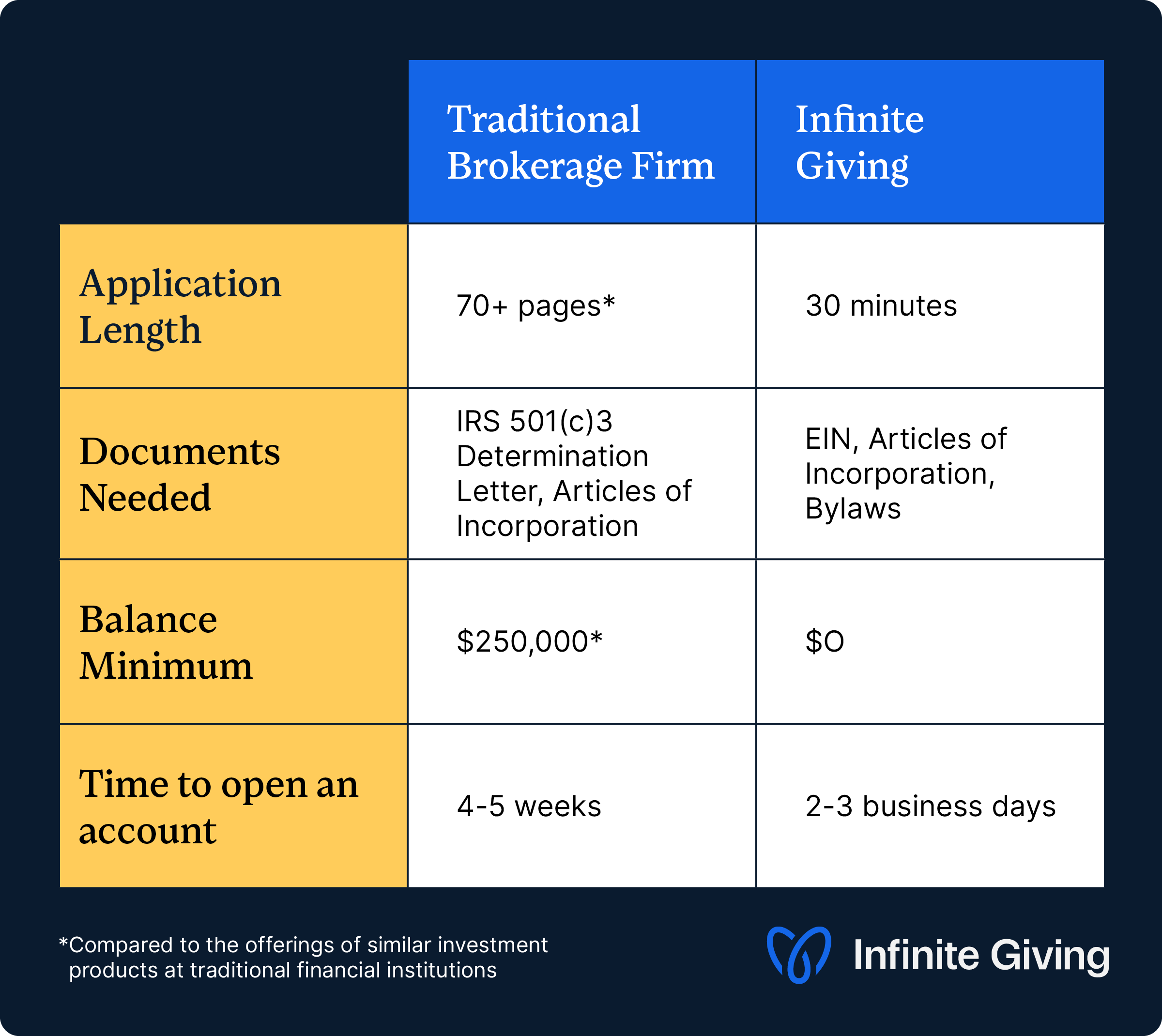
Application length: Traditional brokerage firms’ applications can range from 20-70+ pages long. You can apply for a nonprofit brokerage account with Infinite Giving in as little as 30 minutes online.
Documents needed: Both applications require your IRS 501(c)(3) determination letter and articles of incorporation. However, Infinite Giving can locate your determination letter for you, removing an extra step for your team. Check the specific application requirements for your broker to see if you need any additional documentation.
Balance minimum: Traditional firms can have high balance minimums of $250,000 or more. Infinite Giving’s minimum is $0 to access stock giving and only $100,000 for investing, making it more accessible for smaller organizations.
Time to open an account: You may have to wait 4-5 weeks for approval from a traditional brokerage firm. If you apply for an Infinite Giving account, you can get your nonprofit status verified and open the account in just 2-3 business days.
To prepare for the application process, make sure you have all of the necessary documentation on hand along with approval from internal stakeholders. Meet with your board and nonprofit leadership to discuss the implications of applying for a nonprofit brokerage account and ensure that everyone’s on the same page before moving forward.
3. Start Funding Your Nonprofit Brokerage Account
Once your nonprofit’s brokerage account is open, you can begin adding funds. As mentioned earlier, you may need to move some funds upfront to open the account. Be sure to check with your firm or provider to verify these requirements. Then, you can supplement these original funds by transferring reserve funds from other accounts and soliciting stock donations.
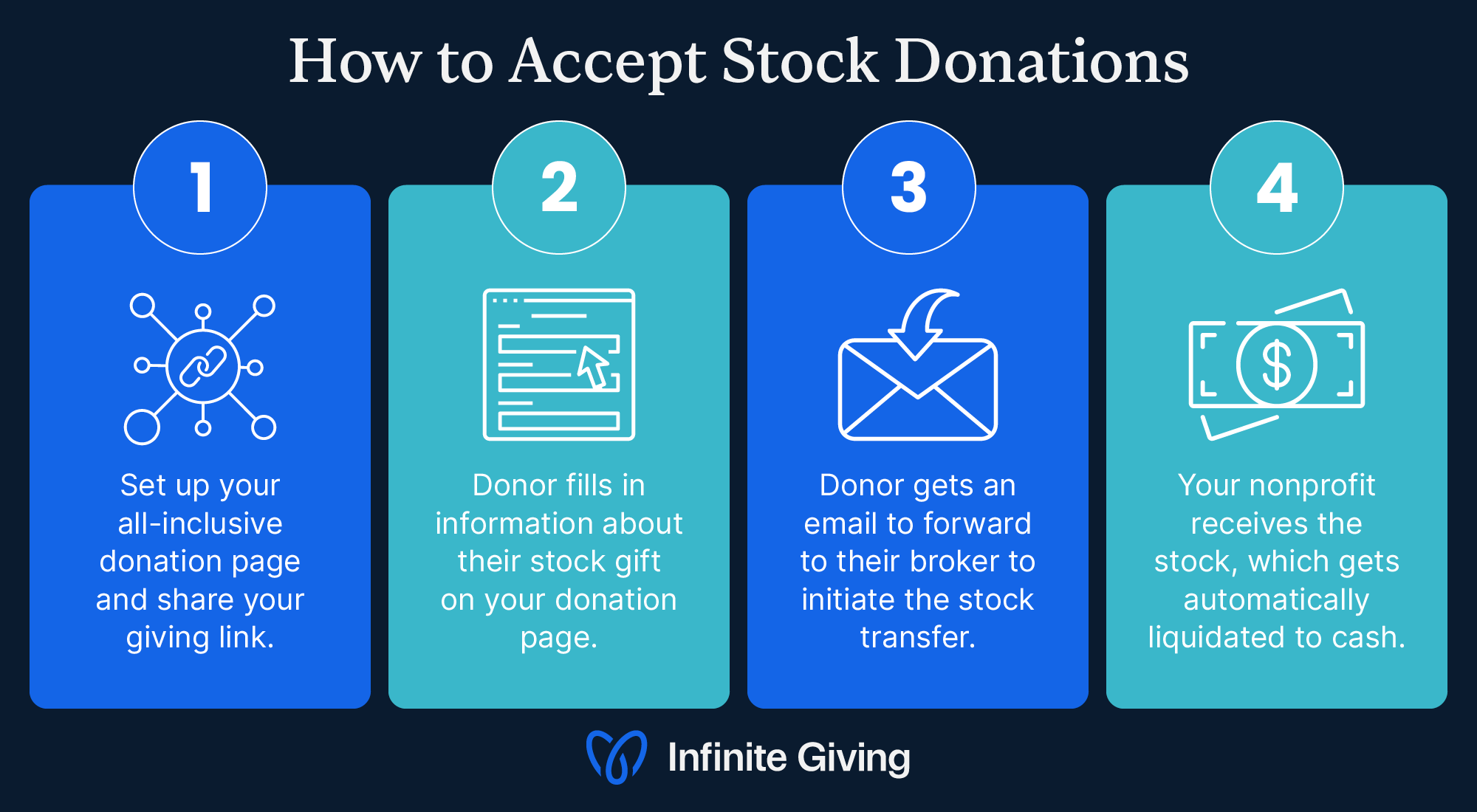
Now that you have the infrastructure in place, you’re ready to accept stock donations and publicize the option to donors. With Infinite Giving, the process of accepting stock gifts works like this:
Set up your all-inclusive donation page and share your giving link. From your branded online donation page, donors can give stocks, cryptocurrency, DAF grants, and endowment gifts.
Donor fills in information about their stock gift. Right from your donation page, they input their contact information, brokerage firm, and information about the stocks they want to donate.
Donor gets an email to forward to their broker to initiate the stock transfer. Immediately after filling out the donation form, they’ll get all the information they need to send to their broker to make the stock transfer request as easy as possible.
Your nonprofit receives the stock, which gets automatically liquidated to cash. Once the transfer is complete, you receive a cash donation and your donor receives a branded stock donation receipt.
Be sure to spread the word about this new giving option by adding information to your Ways to Give page and promoting stock donations across marketing channels. Consider conducting individual outreach to donors you think would be particularly interested, too.
Why You Should Partner with Nonprofit Investment Advisors
Choosing to open your investment account with a nonprofit investment advisor instead of a traditional brokerage firm can significantly affect your experience.
By partnering with a nonprofit investment advisor like Infinite Giving, you’ll receive a variety of additional perks that can help you manage your finances and earn more asset donations. These services include:
Making it easy to accept non-cash donations beyond stocks.
Just take a look at the all-inclusive, branded donation page you’ll receive by partnering with Infinite Giving:
With these financial tools and fiduciary guidance, you can empower your supporters to donate larger amounts in more tax-efficient ways. You’ll also have nonprofit financial advisors by your side every step of the way as you move toward long-term financial sustainability.
Additional Resources
Now that you understand the basics of nonprofit brokerage accounts, you’re one step closer to improving your organization’s cash management. These accounts can open the door to exciting opportunities, like investing and accepting non-cash contributions, which help to further support your mission.
For more insight into everything you can achieve with a nonprofit brokerage account, check out the following resources:
Karen Houghton, CEO and Founder of Infinite Giving
Karen Houghton is the CEO and co-founder of Infinite Giving, a Registered Investment Advisor that helps nonprofits build financial sustainability. With a background in both nonprofit leadership and venture capital, Karen brings a rare blend of heart and strategy to financial stewardship. She is passionate about democratizing access to wealth-building tools and guiding mission-driven organizations toward long-term financial health.
As a trusted advisor and advocate, Karen is reshaping how nonprofits think about money as a powerful resource for growing impact. Her work empowers tax-exempt entities to grow their assets, weather uncertainty, and fund their futures.
*Disclosure
Infinite Giving Advisory Services, Inc. is an SEC-registered investment adviser. Advisory services are only offered to clients or prospective clients where Infinite Giving Advisory Services, Inc. and its representatives are properly licensed or exempt from licensure. This content is solely for informational purposes. Past performance is no guarantee of future returns.
Investors’ experiences may vary from the content. Nothing in this presentation constitutes investment advice, performance data, or any recommendation that any particular security, portfolio of securities, transaction, or investment strategy is suitable for any specific person. Any mention of a particular security and related performance data is not a recommendation to buy or sell that security. Infinite Giving manages its clients’ accounts using a variety of investment techniques and strategies, which are not necessarily discussed in the commentary.
Individualized responses to persons that involve either the effecting of transactions in securities, or the rendering of personalized investment advice for compensation, will not be made without registration or exemption. Investing involves risk and possible loss of principal capital. No advice may be rendered by Infinite Giving Advisory Services, Inc. unless a client service agreement is in place. Donation services provided by Infinite Giving Technologies, Inc.






.gif)