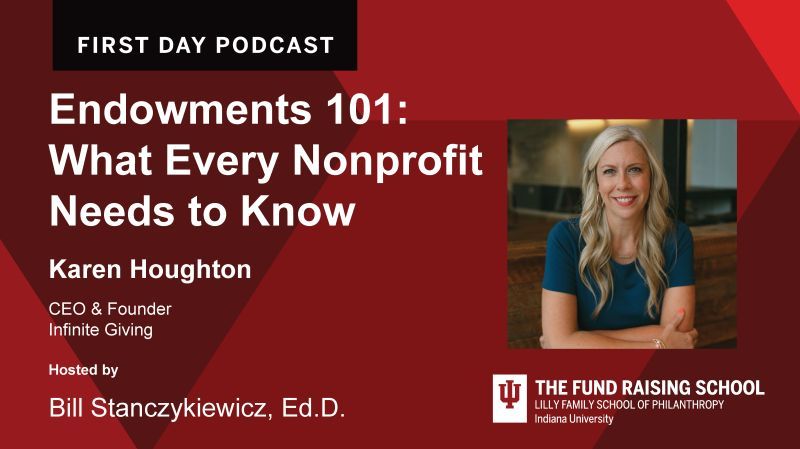
Karen Houghton knows the nonprofit treadmill firsthand. Before founding Infinite Giving, she started a nonprofit serving communities in Rwanda and East Africa. She filed for 501(c)(3) status, opened her first tax-exempt bank account and built a board. She loved the work. She also burned out.
"I experienced the scarcity mindset," she told host James Misner of The Kipos Group on a recent episode of On the Ground. "It was really hard work."
A decade in tech, startups and venture capital followed, along with seats on nonprofit boards ranging from a $2 billion university endowment to organizations building their firfst reserve fund. Along the way, Karen noticed how few people sit on both the finance side and the nonprofit side. That gap became Infinite Giving, which today serves more than 500 nonprofits across the U.S.
Here are the biggest lessons from the conversation for nonprofit leaders who want to move from scarcity to sustainability.
You don't have to be a finance expert
Nobody hires a nonprofit leader for their balance-sheet skills, and Karen thinks that's fine. Leaders should stay focused on the mission. What they often need is permission: to know what peer organizations are doing, what's allowed, and what good stewardship looks like.
"Everybody dreams of financial sustainability of some kind," she says. "How do we get out of the burnout and the scarcity mindset?"
Build a reserve fund, and give it a purpose
When Karen's team reviews a nonprofit's finances, the first gap they usually see is a missing reserve fund, or one that's undesignated and undefined. She compares it to a family emergency fund. If someone loses a job or gets sick, savings keep the household steady. Organizations need the same safety net.
Running month to month wears everyone out. "Your donors get burnt out because it's a constant plea of, how do I keep the lights on?"
How much is enough for a nonprofit to have in cash reserves? Before COVID, three months was common. With today's volatility and grant cuts, Karen sees six to 12 months as the healthy range. Organizations with very predictable funding may be fine closer to three. More than twelve months could mean money sitting idle, so ask what it's for: a new program, a scholarship or the start of an endowment.
Building reserves can mean hard choices, like delaying a new program until it's funded for 12 or 24 months. Karen also suggests dedicating one month of fundraising each year to reserves, even if it takes five years. "You'll find you sleep a little better at night."
Get your reserves out of checking
The second pattern: reserves sitting in checking or low-yield savings, sometimes hundreds of thousands or even millions of dollars. Community banks are great partners for cash flow and bill pay. They aren't built for reserves.
Karen frames it simply. "Would you be happy if a donor came up and wrote you a $10,000 check?" Moving money you already have to a higher-yield home can do the same over a year, and opening an account with Infinite Giving takes about 20 minutes.
What about safety? Infinite Giving separates cash management from investing. Cash management means low-risk, highly liquid options:
- FDIC-insured cash sweeps. Standard FDIC coverage is $250,000 per institution, which is why many boards spread money across several banks. A sweep program extends coverage from a single account. Infinite Giving offers FDIC coverage up to $5 million on cash.
- Federal money market funds, which often yield more than bank money markets.
- U.S. Treasuries, bought directly at government auction.
Funds stay linked to your bank account and transfer back for free. "We're not putting you in Nvidia," Karen says. Infinite Giving serves only nonprofits and works within a conservative financial framework.
Give your endowment a long-term home
An endowment needs to earn enough to fund annual distributions without touching the original gift. That can't happen in a savings account. Karen's advice: start with healthy reserves. With six months of cash in place, you can invest an endowment for the long term and ride out market swings with confidence.
This matters for fundraising, too. Karen estimates that 40 to 70 percent of bequests go into long-term funds like endowments. When small and mid-sized organizations lack that structure, legacy gifts flow to larger institutions. "Big nonprofits stay big," she says, while everyone else stays stuck in the fundraising cycle.
Ask where the wealth actually is
Roughly 90% of U.S. wealth is held in assets, not cash, Karen notes. Yet most nonprofits only ask for credit and debit gifts, and an estimated 85 to 90% don't have a brokerage account to receive stock.
That's asking from the smallest bucket. A $50,000 request feels huge against a $100,000 checking balance. Against an investment portfolio, it feels very different. Giving appreciated stock is also the most tax-efficient option for many donors, who can avoid capital gains tax and deduct the full value. Asking for a check instead means asking them to sell, pay the tax and give you what's left.
Donors also look for organizations ready to receive a significant gift. A payment link alone doesn't signal that.
Opening a brokerage account at a traditional firm can mean high minimums, wet-ink paperwork and six or more weeks. Infinite Giving offers a nonprofit brokerage account opening in a streamlined process: a 20-minute application with a team member on hand, live in three business days.
Karen also cautions against pass-through tools that route stock gifts through a donor-advised fund. Those can cost 3 to 5 percent per gift, and the donor's acknowledgment comes from a third party, not your organization. Direct custody in your own account avoids both. Infinite Giving also matches anonymous stock transfers to the donors who sent them, a problem nearly every organization she asks has faced.
Try, learn and try again
Asked about a time she swung and missed, Karen laughed: "I fail all the time." Donors say no. New ideas don't land. When you care about the work, it feels personal. Her advice is to never attach shame to failure. "If we attach shame to failure, it means we will become unwilling to try."
That spirit applies to finances, too. A reserve fund, a brokerage account and a stock-gift page are all small experiments in stewardship, and each one makes the next gift easier to say yes to.
Keep learning
Want to go deeper? Karen's book, Funding Your Mission: The Modern Guide to Nonprofit Finance, is packed with stories and practical steps.
Ready to put your reserves to work or start accepting stock gifts? Connect with Infinite Giving and we'll help you get started.