

Independent School Endowments: FAQs & Considerations


Many independent schools (private K-12 schools) use endowments as a part of their comprehensive financial stability strategy, but they’re not the best fit for every institution. If you’re thinking about starting an endowment for your school, there are a lot of nuances to consider.
In this guide, we’ll help you understand the basics and determine whether an endowment is worth pursuing. We’ll cover:
- FAQs About Independent School Endowments
- Benefits of Endowment Funds for Private Schools
- How Independent School Endowments Work
- What to Consider Before Starting a School Endowment

FAQs About Independent School Endowments
Can private schools have endowments?
Yes, private, independent schools can have endowment funds. Many schools across the country maintain endowments to improve their long-term financial stability and grow their funding over time.
However, it’s considered a best practice to establish an endowment only after you’ve already built up sufficient operational reserves. These cash reserve funds are designed to be more liquid than endowments, meaning you can liquidate your reserve funds quickly to use them in emergencies or any situation when your school’s funding comes up short. Endowments, on the other hand, are meant for long-term use and are often more restricted, so you typically can’t use them to cover short-term funding gaps.
What’s the purpose of endowment funds for private schools?
Endowments can help schools to increase their financial sustainability and build assets over time. Commonly, independent schools can utilize endowments as designated scholarship funds or capital improvement funds; however, schools and donors can establish endowments for several purposes.
How do schools create endowments?
Your school’s board of directors can create quasi-endowments and seed them with existing funds, or an individual donor can donate an endowment in their name. Either way, independent schools need brokerage accounts and clear investing, reporting, and spending policies to establish endowments.
Why don’t schools use their endowments now?
The public often questions why schools might keep large amounts of money in a bank account instead of using that funding to address today’s needs. This is because most endowments are restricted (unlike reserve funds, which you can use for any mission-relevant purpose). They’re meant to be set aside for future use, grow over the years, and then be used sparingly to support a specific program or project.
How are independent school endowments restricted?
It depends on each endowment’s policies, but they’re typically subject to donor restrictions and annual spending caps.
When donors contribute to an endowment, they may specify that their gift only be used for a certain purpose, like funding STEM scholarships or renovating a specific building. Additionally, most school endowments have disbursement policies that limit annual spending of investment revenue to around 4-5%. The rest of the money stays in the account and gets reinvested to grow the endowment over time.
Benefits of Endowment Funds for Private Schools
If your independent school already has a strong reserve fund and the resources to manage an endowment, starting one can offer the following benefits:
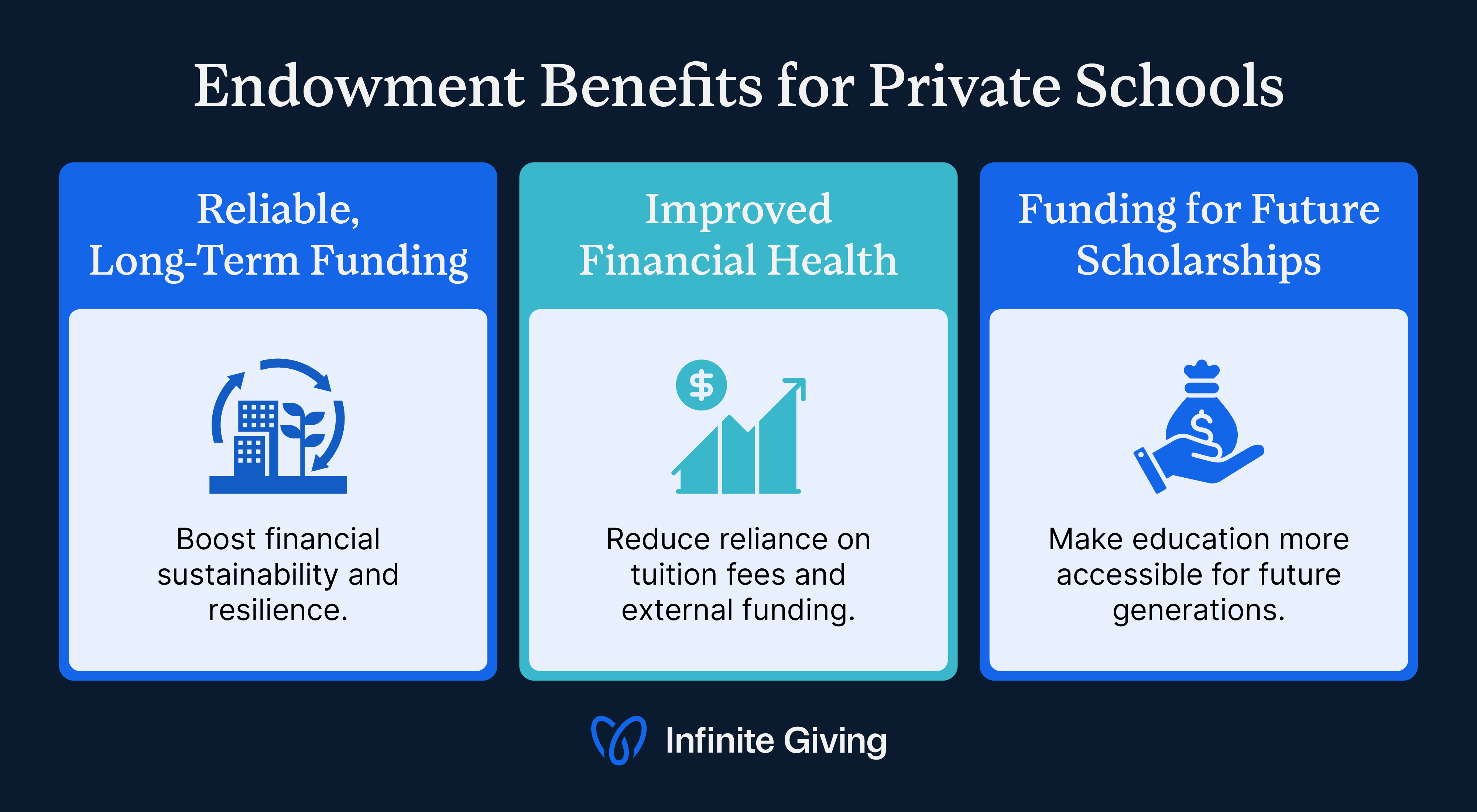
- Reliable, long-term funding: Endowments can help to boost financial sustainability and resilience by designating funds for future use and giving them the opportunity to grow.
- Improved financial health: With a designated fund and regular disbursements you can plan for, your school can reduce reliance on fluctuating funding sources like tuition.
- Funding for future scholarships: Make your school’s education more accessible for future students by growing your scholarship funding in an endowment.
Additionally, endowments can generate the funding you need for capital projects such as building renovations and facility upgrades.
Other schools in the sector have started recognizing and leveraging these benefits. Kim Jennings, a Certified Fund Raising Executive (CFRE) and independent school capital campaign consultant, sees the interest in endowments from independent schools growing. Kim has seen endowments wrapped into schools' campaigns more often than not, taking a more comprehensive fundraising approach.
How Independent School Endowments Work
Now that you understand why private schools have endowments, let’s break down how they actually work.
Establishing a Private School Endowment
Independent schools generally have two options for starting an endowment:
- A donor gifts an endowment to your school as a major gift. Endowments funded by donors typically come with restrictions on how those funds can be used. For example, a major donor may gift your school a $30,000 endowment specifically for the theater program.
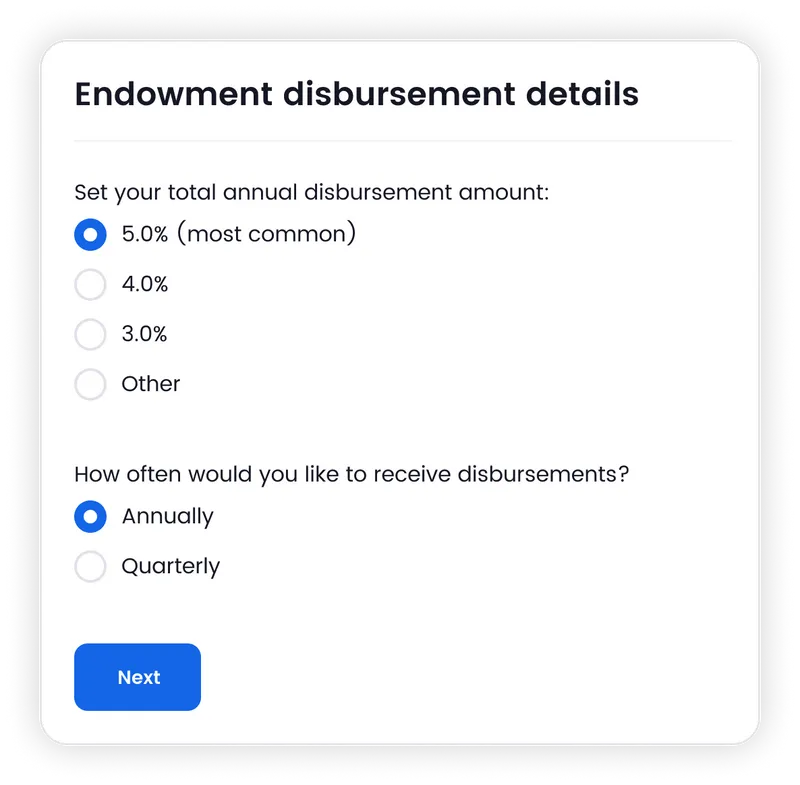
- Your school decides to start its own endowment. Your school’s board could create a quasi-endowment that’s less restrictive than a traditional one by transferring a portion of its reserve funds to serve as the principal investment. The endowment does not need to have one strict purpose, and you may be able to dissolve it at any time, in accordance with your Investment Policy Statement (more on that below).
In the past, establishing your own endowment has been a cumbersome process involving multiple parties. Today, Infinite Giving can help streamline this process for both you and your donors. Your school can set up your endowment with our convenient online process following onboarding. Here’s a snapshot:
Managing Your Endowment
Once established with a principal donation or fund transfer, endowments are invested in the market as long-term legacy gifts that give in perpetuity.
Because your endowment will be invested in the market, your board of trustees must develop an Endowment Fund Policy and a formal Investment Policy Statement (IPS). These policies help you ensure the funds are invested, managed, and spent properly according to the requirements of the endowment.
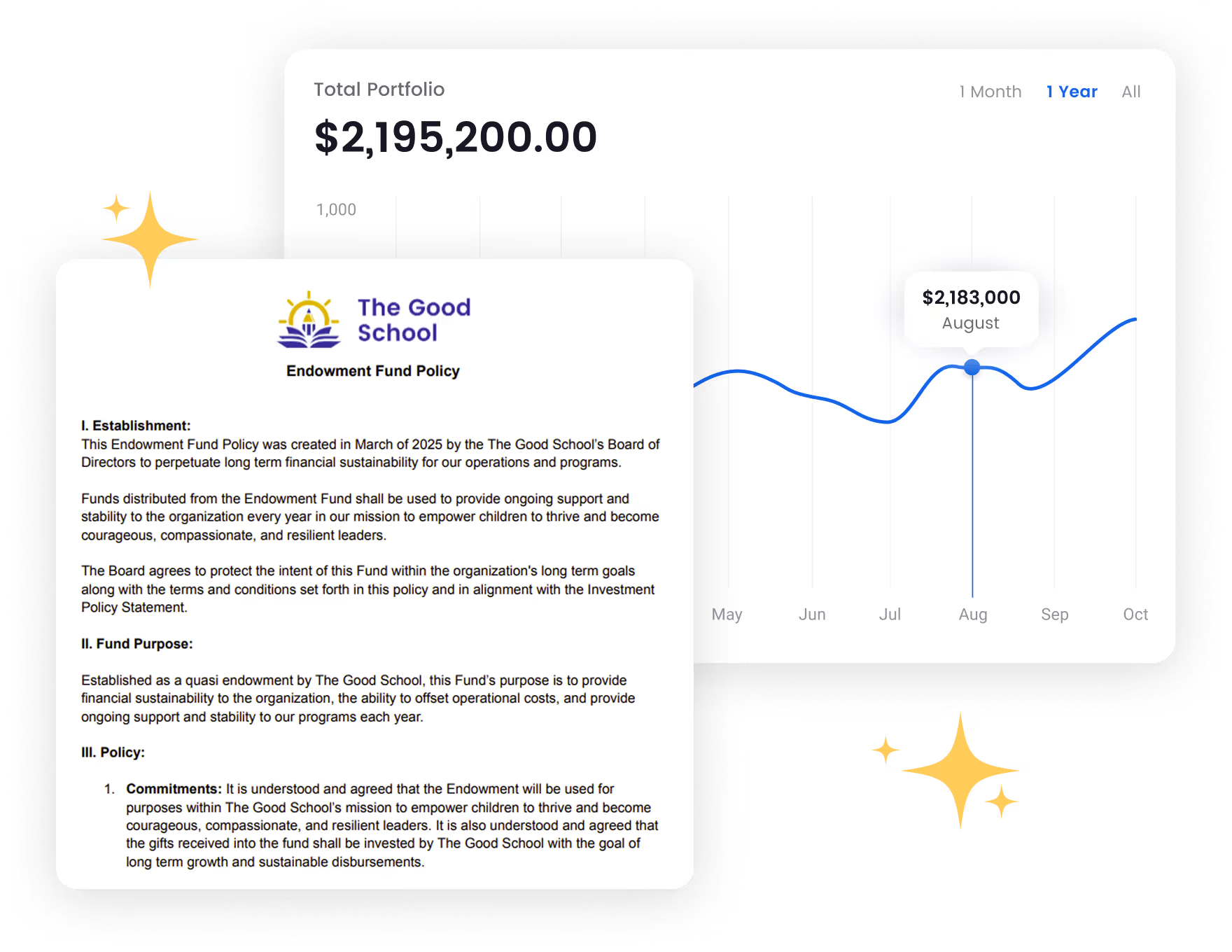
To establish these policies and manage the endowment’s investments, consider partnering with a registered investment advisor like Infinite Giving. These professionals have the investing expertise you need and a fiduciary responsibility to work in your school’s best interest. The right advisor can help you create policies, manage portfolios, report on investment returns, and update your board on the endowment’s standing.
At Infinite Giving, we work exclusively with nonprofits and schools, offering convenience, fund transparency, and reduced fees so you can focus on what matters most: your mission.
Fundraising for the Endowment
Often, endowments aren’t only made up of the principal and investment income. You can also fund them with additional donations and encourage donors to contribute unrestricted funds to help the endowment grow.
In particular, your development and advancement teams can highlight endowments to potential donors interested in legacy or planned giving. With non-cash donation tools, you can even empower donors to contribute their appreciated assets (stocks and cryptocurrency) and access additional tax benefits.
For example, Infinite Giving allows schools to accept cash, stock, crypto, donor-advised fund (DAF), and endowment gifts from one streamlined donation page:

Our team of nonprofit financial experts can support you every step of the way, from evaluating your options and establishing the endowment to managing it and funding it with non-cash gifts. Schedule a call with us to learn more and get started.

What to Consider Before Starting a School Endowment
If you think an independent school endowment could be the right fit for your institution, make sure you consider these factors before moving forward:
- The size of your reserve fund: Do you have at least 6-12 months’ worth of your school’s operating costs in reserve for emergencies? If not, pause on the endowment and build up your reserve fund first.
- Short- and long-term funding needs: What projects, new programs, and scholarships do you need funding for now and in the future? This will help you determine if the endowment should be restricted or if you have more pressing needs to address.
- Your community’s perception: How would your board members, parents, donors, and the wider community react to an endowment? Do you have plans to address any concerns?
- Potential drawbacks: Make sure you understand the limitations and potential drawbacks of endowments. A significant amount of funding may be restricted and illiquid for decades, and you may face additional scrutiny from your community.
Also, think about how you’ll advocate for the endowment if you do move forward. How will you make the case to board members, major donors, and other key stakeholders? Outline a plan for sharing key benefits and having open discussions in support of endowment creation.
Resources for Private School Endowments
To learn more about endowments, investing your school’s funds, and getting the right support, check these resource compiled by our team:
- Nonprofit Endowments: Ultimate Guide to Building Your Fund. Dive deeper into the ins and outs of nonprofit endowments and the process for creating one.
- How to Develop a Nonprofit Investment Policy and Manage Risk. Explore investment policies in more detail, and download a sample policy to see one up close.
- Working with Nonprofit Investment Advisors: FAQs and Tips. Learn what it’s like to work with a registered investment advisor and how to maximize their support.

Karen Houghton, CEO and Founder of Infinite Giving
Karen Houghton is the CEO and co-founder of Infinite Giving, a Registered Investment Advisor that helps nonprofits build financial sustainability. With a background in both nonprofit leadership and venture capital, Karen brings a rare blend of heart and strategy to financial stewardship. She is passionate about democratizing access to wealth-building tools and guiding mission-driven organizations toward long-term financial health.
As a trusted advisor and advocate, Karen is reshaping how nonprofits think about money as a powerful resource for growing impact. Her work empowers tax-exempt entities to grow their assets, weather uncertainty, and fund their futures.
*DISCLOSURE
Infinite Giving Advisory Services, Inc. is an SEC registered investment adviser. Advisory services are only offered to clients or prospective clients where Infinite Giving Advisory Services, Inc. and its representatives are properly licensed or exempt from licensure. This content is solely for informational purposes. Past performance is no guarantee of future returns.
Investors’ experiences may vary from the content. Nothing in this presentation constitutes investment advice, performance data, or any recommendation that any particular security, portfolio of securities, transaction, or investment strategy is suitable for any specific person. Any mention of a particular security and related performance data is not a recommendation to buy or sell that security. Infinite Giving manages its clients’ accounts using a variety of investment techniques and strategies, which are not necessarily discussed in the commentary.
Individualized responses to persons that involve either the effecting of transactions in securities, or the rendering of personalized investment advice for compensation, will not be made without registration or exemption. Investing involves risk and possible loss of principal capital. No advice may be rendered by Infinite Giving Advisory Services, Inc. unless a client service agreement is in place. Donation services provided by Infinite Giving Technologies, Inc.
Explore More
Ultimate Guides
Articles


.jpg)
Grow Your Giving with Expert Nonprofit Financial Advice
