Most donors keep the bulk of their wealth in investments, not in their checking accounts. Yet most nonprofits only ask for cash. That gap was the heart of a conversation with our partner DoGood, where we sat down to talk about stock giving: what it is, why it matters, and how to put it to work for your mission before year-end.
The conversation was hosted by Tyler Emick, account manager at DoGood, with two panelists: Kasey Hardin, Head of Growth at Infinite Giving, and Andy Choi, CEO & Founder of DoGood. DoGood's Nonprofit as a Service (NaaS) platform helps individuals and businesses launch and run a nonprofit starting at $25 a month, often in less than 24 hours.
Kasey's own path to Infinite Giving is a familiar story. When she was the treasurer of a small nonprofit, Kasey spent six months trying to open an account with traditional brokerages to accept a first-time stock gift. After mailing applications around her board for wet signatures, every firm turned her down because the organization wasn't big enough. That frustration led her to Infinite Giving, first as a user and then joining as a member of the team.
Replay the full conversation to learn more about nonprofits as a service and non-cash giving
What a stock gift is, and why it beats cash
A stock gift is exactly what it sounds like. Instead of writing a check, a donor gives shares of a stock or ETF they already own directly to a nonprofit, without selling first.
For donors, it's often the smartest money they can give. If those shares have grown in value, giving them directly means skipping the capital gains tax they'd owe if they sold first and donated the cash. The same gift costs the donor less, and they get a bigger deduction.
For nonprofits, it means bigger gifts. The average online cash gift in the US is about $128. The average stock gift is around $8,000, and through Infinite Giving's platform, it was over $30,000 last year.
Kasey pointed to where people actually keep their money. Donors hold roughly 90% of their wealth in assets and only about 10% in the bank. "If you're only asking donors from that small checking account amount that is hard for donors to part with, then you're missing out on a ton of opportunity," she said.
The misconceptions holding everyone back
Andy noted that many donors simply don't know they can give stock. They assume they'd have to sell, deal with capital gains, and sort out the write-off themselves. Many nonprofits don't realize they can ask for it, either.
Kasey added a second myth: that stock giving is complicated and only for wealthy donors or large organizations. In reality, anyone holding stock that has grown in value can benefit. "Instead of paying capital gains tax to the government, give that money to the nonprofit," she said.
On the nonprofit side, Kasey hears one hesitation constantly: "We don't know if we have any donors who want to give that way." She calls it the chicken-and-egg problem. Donors know nonprofits are stretched thin, so they rarely request a giving method that isn't already set up. Offer it, make it easy, and put it on your website, and you'll likely discover donors who were waiting for the option.

How it works, from donor to deposit
With the right setup, a stock gift can take a donor just a few minutes to complete. Here's the flow Kasey walked through:
- The donor (or their financial advisor) visits the nonprofit's donation page and chooses "Give stock" in the branded Infinite Giving widget.
- They fill out a short form: name, email, brokerage firm, the stock, and the number of shares.
- They receive transfer instructions and a link to a donation tracker, where they can follow the gift and loop in their advisor.
- Once the shares arrive in the nonprofit's brokerage account, Infinite Giving sells them automatically. That's a best practice, since holding a single stock is too risky for most nonprofits.
- The cash goes to the nonprofit's bank account or into a diversified portfolio, and the donor gets their tax receipt automatically.
The nonprofit gets an email when the gift comes in and can track it on their dashboard. Infinite Giving charges no transaction fees on stock gifts to the nonprofit or the donor, and the process takes about five days from receipt to funds.
For DoGood NaaS clients, it's even simpler. Stock giving is included in their standard account, and a DoGood account manager handles the process for them. Andy shared an example of a NaaS client whose donor wanted to give stock: DoGood and Infinite Giving handled the paperwork, tax receipt, and liquidation, then deposited the funds straight into the client's account.
How to make the ask (and why timing matters)
Andy's advice starts with awareness. He shared the story of a friend who invested early in Nvidia and has been sitting on the shares, since selling would trigger a huge capital gains bill. He had no idea he could give stock and deduct the full value. Andy encouraged nonprofits to understand their donors' situations and treat stock giving as an ongoing conversation, not a one-time ask.
Kasey's advice: make stock an option, not a big separate ask.
- Put "Give stock" on your donation page next to card and bank options.
- Add one line to your year-end letter or email, such as: "If you hold stock that's grown in value, giving the shares directly may save you on taxes and lead to a bigger deduction."
- Don't worry about being the tax expert. Many donors will forward it to their financial advisor, and that's perfect.
Timing matters, too. A big share of stock gifts happen in December. For a gift to count toward 2026, the shares must arrive in the nonprofit's brokerage account by December 31. Brokerages move at different speeds, so encourage donors to start their transfers by early to mid-December.

Beyond stock: crypto, DAFs, and endowments
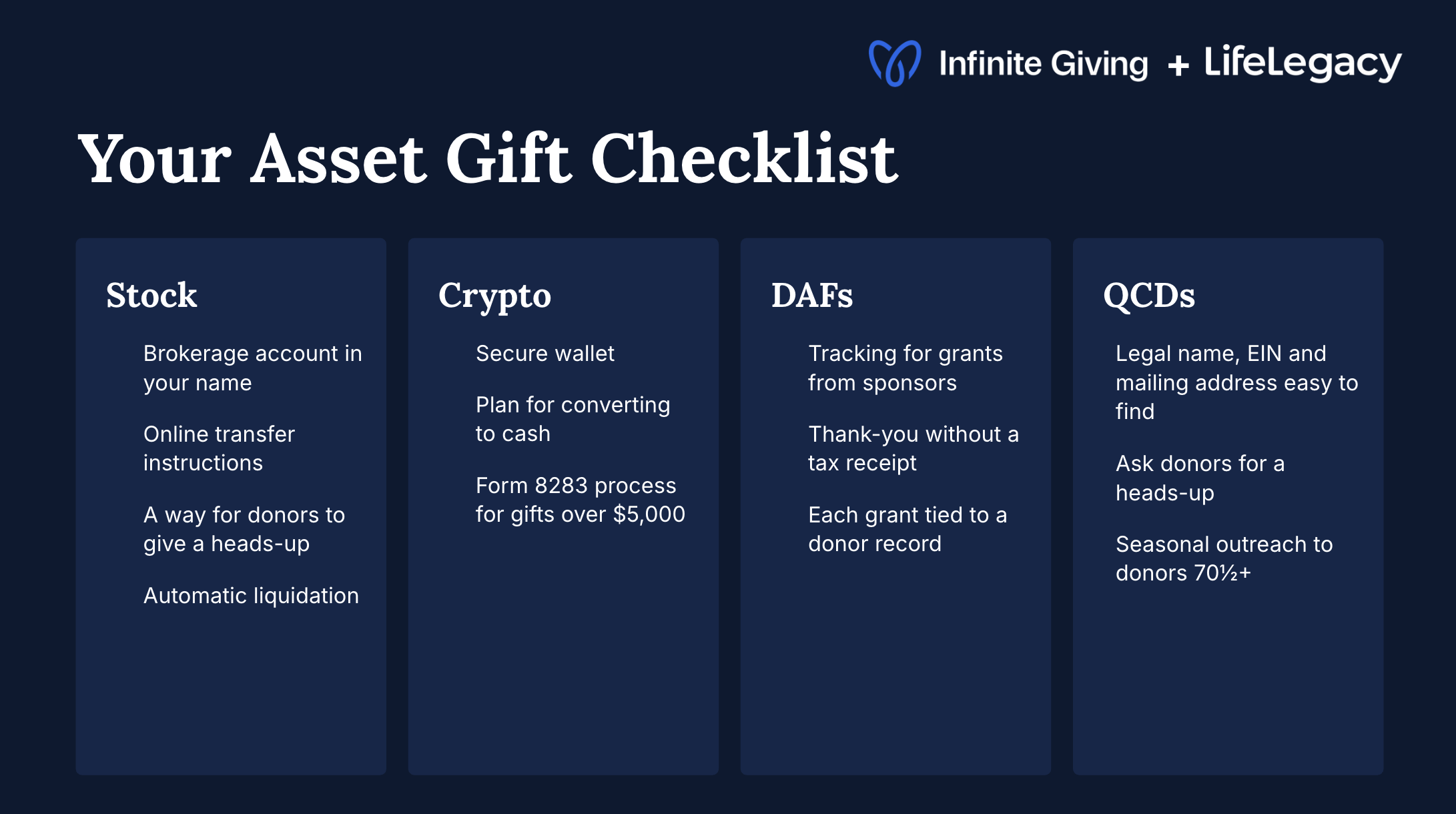
Stock is just one type of asset gift. Through Infinite Giving, nonprofits can also accept crypto, donor-advised fund (DAF) grants, and endowment gifts. The pattern holds across all of them: asset gifts average 60 to 100 times larger than cash. Average crypto gifts top $10,000, DAF grants top $12,000, and endowment gifts typically start at $25,000.
- Crypto: Infinite Giving accepts it, liquidates it, deposits the funds, and sends the donor a receipt. Your team never has to hold or manage crypto.
- DAF grants: Donors can leave a pledge through the widget with the amount and their contact information, so you know who's giving and can say thank you sooner.
- Endowments: Infinite Giving helps with first-time endowments, from policies to investments to disbursements, at a 0% fee.
Andy also highlighted a lesser-known opportunity: donors can use a stock gift to fund their own nonprofit. In fact, DoGood's partnership with Infinite Giving started when a client wanted to launch a passion project with appreciated stock. Whether it's planting trees or supporting a local church, idle assets can become active impact.
Your year-end game plan
With Giving Tuesday and year-end around the corner, the panel's advice was clear: don't wait for donors to ask, because they often won't. As Kasey put it, "You're not asking for more, you're offering a smarter way to give."
- Add stock giving to your donation page now.
- Mention it in your Giving Tuesday and year-end appeals.
- Remind donors to start transfers by early to mid-December.
- Think beyond this year. Every conversation about assets builds a relationship that can grow over time.
As Andy said, if you're wondering whether the juice is worth the squeeze, it absolutely is.
Ready to start accepting stock and other asset gifts? Get started with Infinite Giving. DoGood NaaS clients already have access today.