

Planned Giving vs. Endowments: How They Work Together

For many nonprofits, moving from year-to-year survival toward long-term financial sustainability is a key priority. While short campaigns and annual appeals may keep programs funded for now, this approach rarely builds the foundation needed to plan five or ten years ahead.
Planned giving and endowments can both offer a path toward that kind of stability, but they are often treated as isolated strategies. Leveraging them together can help your organization maximize the impact of both, turning one-time, large legacy gifts into a potential long-term funding source.
This guide breaks down planned giving and endowments, where they overlap, and how pairing them can work in practice. We’ll cover:
- Planned Giving vs. Endowments FAQ
- Understanding Planned Giving & Endowments
- How Planned Giving & Endowments Work Together

Planned Giving vs. Endowments FAQ
What is planned giving?
Planned giving, also known as legacy giving, refers to philanthropic contributions drawn from a donor's accumulated wealth (e.g., estate bequests, stocks, or DAFs) to sustain a nonprofit's long-term mission. Because the gift typically comes from a donor's estate rather than their everyday income, planned giving can offer donors a way to contribute large amounts that make a lasting statement about the causes they care about most.
What is an endowment?
An endowment is a dedicated pool of invested assets owned by a nonprofit that is designed to keep its original gift (the principal) invested while generating a stream of income to sustain the organization's mission. While the principal generally stays invested, most organizations draw a portion of the investment returns each year to fund programs, general operations, or other needs.
What is the difference between planned giving and an endowment?
Planned giving refers to how a gift is delivered, while an endowment refers to where that gift may be held and invested once a nonprofit receives it. A few other distinctions worth noting include:
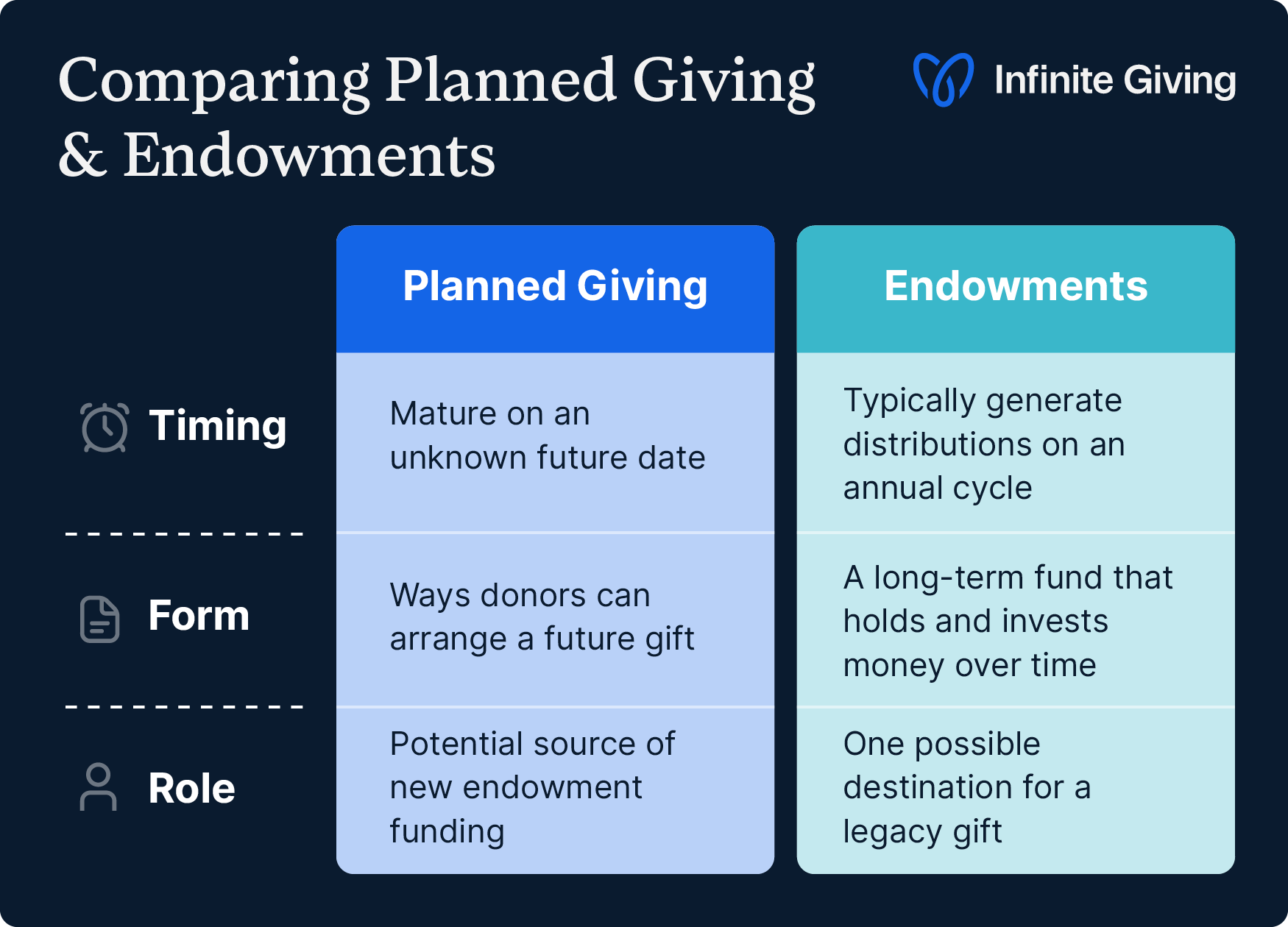
- Timing: Planned gifts often mature on an unknown future date, usually tied to a life event like the donor’s passing. Once established, endowment funds typically generate distributions on an annual cycle.
- Form: Planned giving encompasses a variety of ways donors can arrange a future gift (such as bequests, trusts, and retirement account beneficiary designations). An endowment is a long-term fund that holds and invests money over time, and it can take a few different forms (true, quasi, term, micro-endowments, etc.).
- Role: A planned gift can be used as the source of new endowment funding, and an endowment is one possible destination for that funding.
These two are not competing strategies pulling in different directions. In many cases, they overlap directly, since a planned gift can fund the endowment's principal and give that fund room to grow.
Understanding Planned Giving & Endowments
Planned giving and endowments each address a different aspect of funding your mission beyond this year's budget. Let’s walk through how each strategy works, along with common advantages and trade-offs:
Planned Giving
Planned giving programs exist to capture support that a donor could not otherwise give during their lifetime, turning years of donor loyalty into a future resource for your nonprofit. Because legacy gifts are drawn from accumulated wealth rather than the donor’s disposable income, they tend to be among the largest gifts a supporter makes to your organization.
While a planned gift can take years to arrive, it can also fund work at a scale that annual giving alone rarely reaches.
Types of Planned Gifts
Some of the more common types of planned gifts include:
- Bequests: A gift designated in a donor's will or living trust, which is payable to your nonprofit after their lifetime.
- Trusts: These are legal arrangements that direct assets to your nonprofit, either immediately or after a set period. There are several different types of trusts (including charitable remainder trusts and charitable lead trusts), and each is structured around when your organization and other beneficiaries receive funds.
- Charitable gift annuities: A contract where a donor gives assets to your nonprofit in exchange for fixed payments back to them for life, with the remainder going to your organization.
- Retirement assets: This gift involves the donor naming your nonprofit as a full or partial beneficiary of their 401(k), IRA, or similar account.
- Life insurance: Similar to retirement assets, this type of gift involves the donor naming your nonprofit as a beneficiary of a life insurance policy, or transferring ownership of an existing policy outright.
- Retained life estates: A donor gifts real estate to your nonprofit while retaining the right to live in or use the property for the rest of their life.
Potential Benefits and Disadvantages
Planned giving can offer key advantages, along with a few trade-offs that are worth planning around:
Benefits:
Planned giving tends to:
- Be attractive to donors. Planned gifts make it possible for donors to leave a legacy without seeing an immediate financial impact, often with meaningful tax advantages.
- Offer transformational gifts. Because legacy gifts are drawn from accumulated wealth rather than disposable income, they tend to be among the largest a donor will give.
- Build a predictable, long-term pipeline. While the funds may not be available right away, a mature planned giving program can provide a dependable foundation of expected future gifts.
- Deepen donor loyalty. Legacy donors tend to keep giving throughout their lifetimes, not just at the end of it. These commitments are deeply personal, indicating the donor’s affinity and passion for your cause.
Drawbacks:
In addition to the benefits, there are a few disadvantages of planned giving to consider, such as:
- Increased cost and complexity: Planned gifts involve more steps than a standard donation, and the process often requires specialized knowledge from third parties like attorneys and financial professionals. This can make it difficult for a nonprofit to manage planned gifts on its own. Fortunately, Infinite Giving’s fiduciary advisors can help guide the process, from structuring the gift to integrating it with your broader financial strategy.
- Unpredictable timing: These gifts are often significant and can lay a solid foundation for the future. However, the exact date any single gift matures is rarely known in advance, which can make planning more challenging.
- Risk of revocation: Donors may change their minds about the gift or need to redirect the funds toward something else, like unexpected medical care. It’s worth remembering that a promised bequest is not the same as a received one.
Endowment Funds
An endowment fund is designed to keep the original gift, the principal, invested rather than spent. Here's a simplified breakdown of how this typically plays out over time:
- A nonprofit establishes or receives a gift into an endowment fund.
- The fund is invested according to the organization's goals and risk tolerance.
- Each year, a limited percentage of the fund (typically 4% to 5% of the fund’s total market value) is distributed for programs or operations.
- The remaining principal stays invested in perpetuity, with a goal of continued growth over time.
Instead of having to chase down a new round of donations annually, an established endowment can help support the same mission year after year, provided it's managed with a sound investment and spending policy.
Types of Endowment Funds
As with planned gifts, there are several different types of endowments:

- True endowments: For these funds, the donor has permanently restricted the principal, meaning it can never be spent, only invested.
- Restricted endowments: The donor has placed conditions on how the income can be used, such as funding a specific program.
- Unrestricted endowments: The nonprofit has the power to make decisions on how the investment income is used.
- Term endowments: These funds are designed to exist for a set number of years or until a specific event occurs, after which the principal can be spent.
- Quasi-endowments: The nonprofit's board designates funds as an endowment using unrestricted assets, rather than a specific gift from a donor. Because there's no legal restriction, the board could vote to access the principal if needed.
- Micro-endowments: These smaller endowments, often with narrowly designated funds, are sometimes used to test an endowment strategy before committing to a larger fund. Or, an individual donor might gift your nonprofit a micro-endowment (with or without restrictions) in their name.
Potential Benefits and Disadvantages
As with planned gifts and other fundraising methods, there are both pros and cons of nonprofit endowment funds that it’s important to be aware of:
Benefits:
Endowments can allow you to:

- Establish a reliable funding source. An endowment can provide your nonprofit with a predictable stream of income to lean on, which can help to make annual budgeting simpler.
- Attract significant gifts. A well-run endowment could signal to prospective donors that an organization is disciplined and prioritizes financial sustainability and longevity, making it easier to attract large gifts.
- Create donor legacies. For donors with significant assets, contributing to an endowment can come with meaningful tax advantages while also allowing them to turn that single gift into a source of support that may outlast them by decades.
Disadvantages:
On the other hand, there are some potential drawbacks to watch for, including:
- Public perception: Endowments aren’t immune to criticism. Some, particularly at universities, have faced pressure to divest from specific holdings.
- Potential donor pushback: Not every donor sees an endowment as a positive use of funding. Some may interpret it as money being set aside rather than put to use, especially in years when only a small portion is distributed.
- Associated risk: Investing always carries some level of risk, even when a fund favors low-risk, highly liquid assets. Boards with a lower risk tolerance may not be comfortable with this.
- A long time horizon: Endowments are a slow-building strategy rather than a quick fix. Organizations that are facing more immediate funding needs may find that the timing doesn't line up with their current goals.
How Planned Giving & Endowments Work Together
Planned giving and endowments can work together with the right strategies. After all, planned giving is a common way many nonprofits grow their endowment fund in the first place, and combining the two may turn a one-time legacy gift into years of recurring support.
You might view planned giving as the seed, and the endowment as the soil. The seed (a bequest, trust, or other planned gift) is how the money arrives. The soil is where that money is planted, invested, and given room to grow into something larger than the original gift.
To make this connection work in practice, it can help to explicitly link a planned giving program to an endowment, rather than letting the two run on separate tracks. Check your strategy against the donor’s original restrictions and your organization’s own endowment policy.
Here's an example of what this lifecycle might look like:
- A donor makes a commitment by including a $100,000 bequest to the nonprofit in their will.
- Years later, the donor passes away, and the nonprofit receives the gift.
- Following the donor's wishes, the organization deposits the lump sum into its endowment, adding to the principal.
- The endowment is professionally invested in accordance with the nonprofit's goals and policies.
- The nonprofit's board approves an annual distribution that does not exceed average annual returns or inflation.
- The majority of the fund continues to be invested, giving it the potential to grow long-term. This means that the initial planned gift could eventually pay out far more than its original value.
Each of these strategies relies on the other to be successful. Planned gifts may need a place to grow, and an endowment needs a reliable source of principal. Paired together, they could transform a single large, one-time gift into something closer to a sustainable, predictable revenue stream.
Considerations for Pairing Planned Gifts & Endowments
When leveraging legacy giving and endowments together, keep the following considerations in mind:
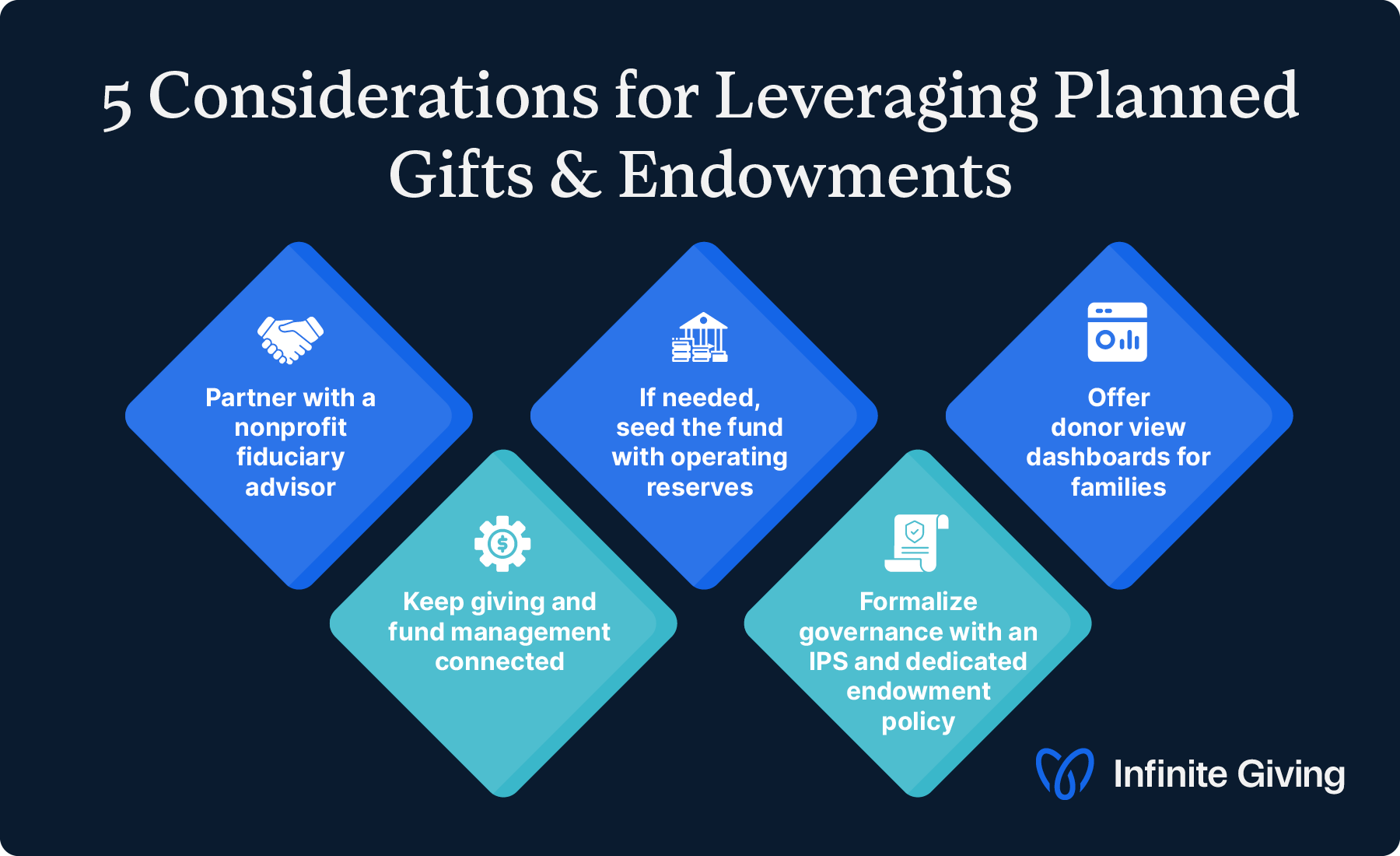
- Partner with a nonprofit fiduciary advisor. Managing the legal, tax, and investment sides of this pairing can be a lot to take on alone. Registered investment advisors, like the team at Infinite Giving, are bound by fiduciary responsibility to work in your organization’s best interest, helping you manage your nonprofit’s finances in line with your policies and mission. Organizations that work with Infinite Giving can also access discounts on legacy giving software through its partner, LifeLegacy, which focuses on the planned giving side of this pairing.
- Keep giving and fund management connected. A planned gift typically starts on a nonprofit's donation page and then moves into an ongoing investment and cash management process for the endowment. If those two processes run on separate, disconnected systems, it can be more difficult to keep gift tracking and fund oversight aligned. Consider providers like Infinite Giving, which pair donation page support with cash management services to solidify that connection.
- If needed, seed the fund with operating reserves. Consider this step if your nonprofit doesn't already have an endowment or receive one from a donor. Boards might consider seeding an initial board-designated quasi-endowment with existing cash reserves that exceed six to twelve months of operating expenses. This can help demonstrate financial maturity and allows you to invite donors to contribute to an existing, working fund.
- Formalize governance with an Investment Policy Statement (IPS) and a dedicated endowment policy. An IPS is a roadmap for managing your nonprofit’s investments, describing the types of investments you can make with the endowment, specific strategies, and target returns. Additionally, consider drafting disbursement and usage policies that outline the amount your nonprofit can withdraw from the fund annually and how the fund and its income can be used.
- Offer donor view dashboards for families. For donors who gift a named endowment, such as “the Smith Family Endowment”, a dashboard can give their family ongoing visibility into how that specific fund is performing and being used. This visibility is generally limited to these named endowments rather than contributions to an existing, unnamed fund.
It can also help to revisit this pairing at least once a year. Endowment policies, distribution rates, and even donor restrictions may need to shift over time, and regular check-ins between your team and your fiduciary partner can catch and address any misalignment before it becomes a bigger problem.
Building a Sustainable Giving Strategy
Planned giving and endowments can often go further together than they can on their own. With clear policies, guidance from fiduciary advisors, and regular review of how the two strategies fit together, a single legacy gift has the potential to grow into a compounding source of funding that supports your mission well into the future.
To make pairing planned giving and endowments more accessible, Infinite Giving provides fiduciary advisory services and a range of resources to help answer your questions. Check out these additional resources to learn more:
- The Basics of Nonprofit Financial Management: Start Here. Get a broader look at how nonprofits can build strong financial management strategies that promote long-term sustainability.
- Independent School Endowments: FAQs & Considerations. Run a private school? See how an endowment strategy applies to your organization.
- Nonprofit Investing: The Ultimate Guide to Grow Your Giving. Explore guidance on how to approach investing your reserve funds.

*DISCLOSURE
Infinite Giving Advisory Services, Inc. is an SEC registered investment adviser. Advisory services are only offered to clients or prospective clients where Infinite Giving Advisory Services, Inc. and its representatives are properly licensed or exempt from licensure. This content is solely for informational purposes. Past performance is no guarantee of future returns.
Investors' experiences may vary from the content. Nothing in this presentation constitutes investment advice, performance data, or any recommendation that any particular security, portfolio of securities, transaction, or investment strategy is suitable for any specific person. Any mention of a particular security and related performance data is not a recommendation to buy or sell that security. Infinite Giving manages its clients' accounts using a variety of investment techniques and strategies, which are not necessarily discussed in the commentary.
Individualized responses to persons that involve either the effecting of transactions in securities, or the rendering of personalized investment advice for compensation, will not be made without registration or exemption. Investing involves risk and possible loss of principal capital. No advice may be rendered by Infinite Giving Advisory Services, Inc. unless a client service agreement is in place. Donation services provided by Infinite Giving Technologies, Inc.
The information, opinions, and views expressed in this material are provided as of the date indicated and are subject to change without notice. No obligation is undertaken to update or revise this material to reflect events or circumstances occurring after the initial publication date.
Explore More
Ultimate Guides
Articles



Grow Your Giving with Expert Nonprofit Financial Advice
